There's a moment — if you've ever walked into a poorly designed hospital — where the weight of illness meets the chaos of everything around you. A confusing floor plan that makes a sick person walk twice as far as they should. Corridors lit so harshly they feel more like interrogation rooms than healing spaces. The sharp smell of disinfectant doing its best to cover something you'd rather not think about. In that moment, the building itself becomes part of the suffering. You feel small. Disoriented. Like the space was designed for a system — not for you. Now imagine the opposite.
Imagine arriving at a modern hospital in Loni and feeling the shift the moment you step through the entrance. The light is warm and natural — not fluorescent, not blinding. The air moves. The corridors make sense. The waiting area doesn't feel like a waiting area; it feels like a space where someone considered what it means to sit there, worried, hoping for good news. The architecture doesn't announce itself loudly — it simply works, quietly and completely, in your favour. That is not an accident. That is intentional healthcare design.
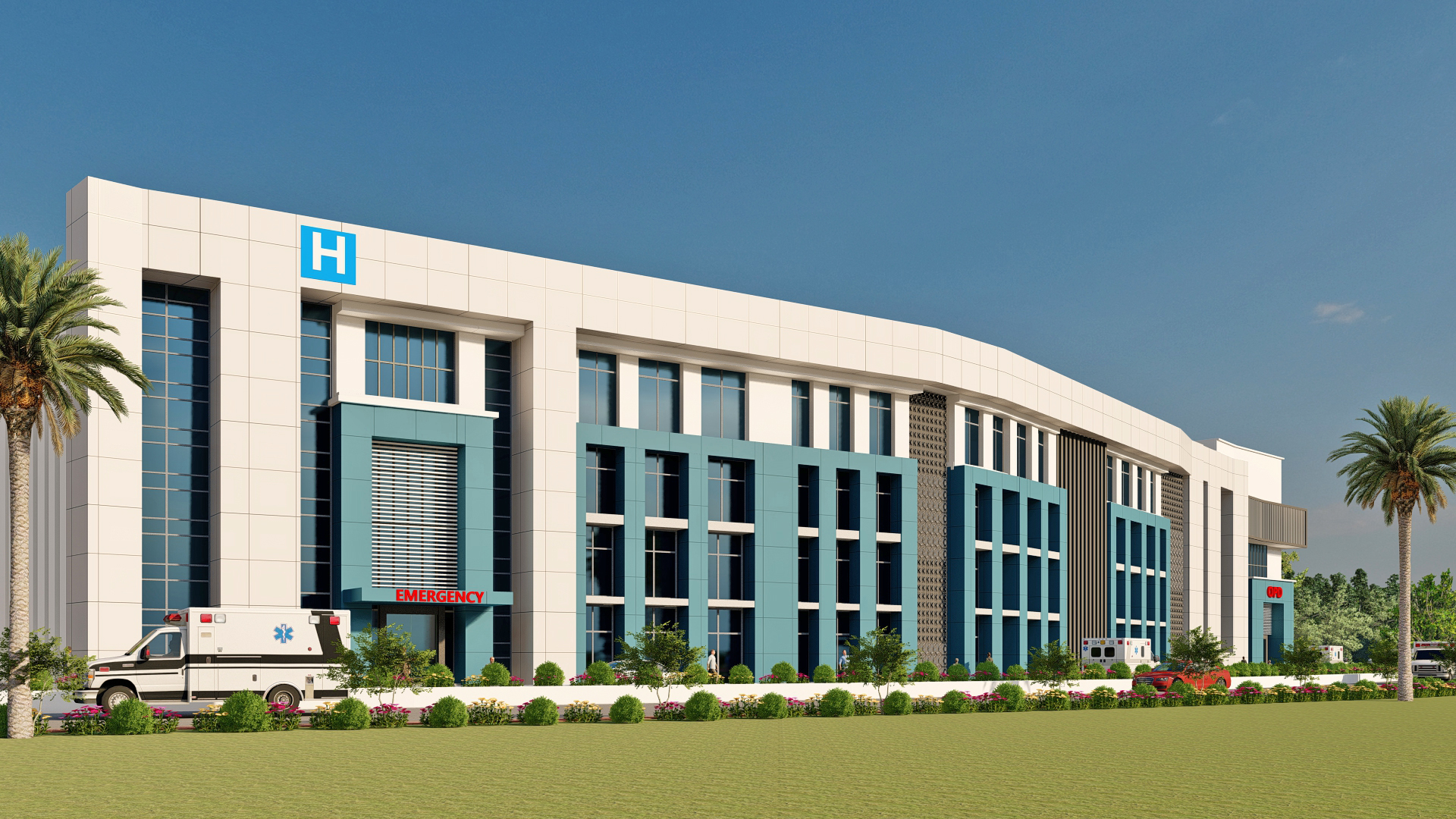
And that is precisely the experience that the Hospital in Loni — envisioned by ArchitectsHive, one of the leading architecture firms in Delhi NCR, for Mr. Sharma — was built to deliver from the ground up. Spanning 18,321 sq. ft. of thoughtfully planned, patient-first space, this is far more than a facility that houses beds and medical equipment. It is a carefully constructed environment where hospital interior design, sustainable architecture, and evidence-based spatial planning come together to redefine what healthcare infrastructure in the Delhi NCR region can genuinely look, feel, and function like. This is modern hospital architecture in India — not as it has been, but as it should be.
Why Hospital Architecture in India Deserves a Serious Conversation
Let's be honest — for too long, hospital design in India has been an afterthought. Functionality was the only metric. If the OPD could fit 200 patients and the emergency ward had enough beds, the job was considered done. Aesthetics, patient psychology, spatial flow, healing environments — these were luxuries nobody was designing for.
But the data tells a different story. Studies in evidence-based healthcare design have consistently shown that thoughtfully designed hospital environments reduce patient anxiety, shorten recovery times, lower staff fatigue, and even decrease medical error rates. Natural light, intuitive navigation, reduced noise levels, connection to greenery — these aren't decorative decisions. They're clinical ones.
The best hospital architects in India are finally catching up to this global understanding. And the Hospital in Loni is proof that Delhi NCR is leading that shift.
First Impressions: A Facade That Builds Trust Before You Step Inside
The exterior of any hospital carries an enormous psychological burden. It must communicate reliability without being intimidating, modernity without being cold, and professionalism without being sterile.
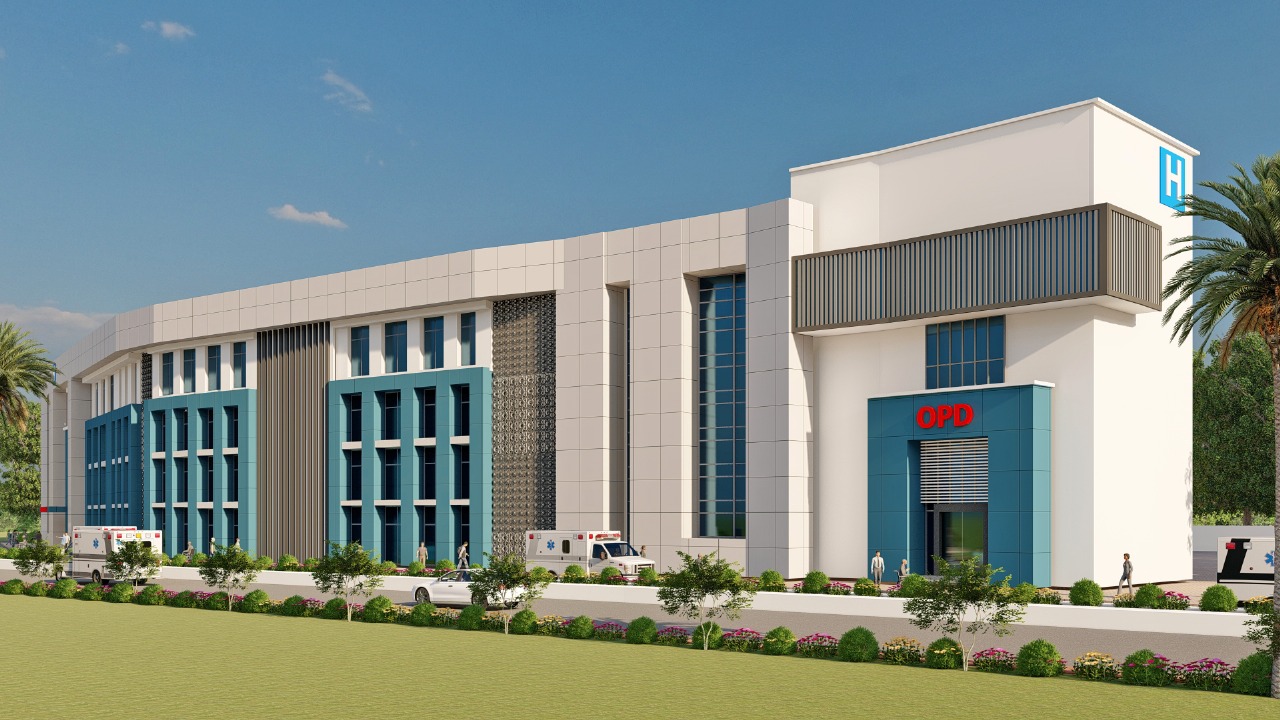
The Hospital in Loni achieves this balance through a confident architectural language — blue-toned aluminium composite panels paired with crisp white structural lines that give the building a clean, institutional gravitas. The symmetry of the façade is deliberate: symmetry signals order, and order signals safety. For a patient arriving in distress, that visual cue matters more than most architects realize.
The large-format windows running across the elevation aren't just aesthetic choices — they flood interior spaces with natural daylight, eliminating the oppressive fluorescent glare that defines so many older hospitals. Landscaped green belts soften the building's edges and create a transitional zone between the busy road and the healing environment within.
This is exterior healthcare design done with intention — and it's the kind of architectural thinking that is placing Delhi NCR firms at the forefront of modern hospital design in India.
Inside the Plan: How Smart Zoning Saves Lives
If a hospital's exterior is its promise, the interior plan is its delivery.
The floor plan of the Hospital in Loni was developed around one central question: what does a patient — or a doctor in an emergency — need most? The answer is almost always the same: clarity, speed, and the absence of friction.
OPD Zone — Designed for Dignity
Outpatient departments in India are notorious for their overcrowding, poor acoustics, and lack of privacy. In this project, the OPD zone was designed to handle high daily footfall while maintaining individual patient dignity. Waiting areas are generously proportioned, well-ventilated, and separated from the clinical examination areas — reducing the anxiety of the wait and protecting the privacy of consultation.
This isn't just good design. It's good medicine.
Emergency Wing — Speed Encoded in Space
The emergency department was positioned to allow direct ambulance access with zero internal obstructions. The triage zones are clearly delineated, with direct visual connectivity between nursing stations and patient bays. Every metre of this wing was planned to shave seconds off response times — because in emergencies, seconds are everything.
This approach to emergency ward design reflects a global shift in thinking: the best hospitals aren't designed around what's convenient for administrators, they're designed around what's critical for patients.
Circulation — The Invisible Architecture
Perhaps the most undervalued aspect of any hospital design is its circulation strategy — the invisible network of corridors, stairwells, and service routes that determines whether a facility runs smoothly or descends into chaos.
At the Hospital in Loni, patient movement, staff access, and medical supply routes are kept deliberately separate. This tripartite circulation system does two crucial things: it dramatically reduces cross-contamination risks, and it ensures that a nurse rushing with medication never collides with a patient being wheeled to a scan. In infection control terms alone, this separation is worth its weight in gold.
The Healing Environment: Where Architecture Meets Human Psychology
This is where the Hospital in Loni moves beyond mere function into something more profound.
Healthcare architecture research has established what intuitively makes sense: people heal faster in beautiful spaces. Not luxurious — beautiful. There's a difference. Luxury is marble and chandeliers. Beauty, in the context of healing, is natural light, calm colours, spatial breathing room, and visible greenery.
The design team at ArchitectsHive incorporated every one of these elements:
- Natural daylight was maximised through strategic window placement on all patient-facing elevations, reducing dependence on artificial lighting and naturally regulating circadian rhythms — which directly impacts recovery.
- Colour palettes were selected from the cooler, more neutral end of the spectrum — whites, greys, soft blues — clinically proven to lower cortisol (the stress hormone) in both patients and healthcare workers.
- Green landscapes visible from waiting areas and recovery spaces create a passive connection to nature that research calls restorative. Even a view of greenery through a window has measurable positive effects on patient outcomes.
This is biophilic design in healthcare — and it's the future of hospital architecture in India.
Sustainable Hospital Design: Building for the Next 50 Years
A hospital built today must still be functional, efficient, and relevant in 2050. That's a long-time horizon, and it demands sustainable thinking at every level of design.
The Hospital in Loni integrates sustainability not as a green credential checkbox, but as a fundamental design value:
Energy Efficiency: The building's orientation, window placement, and shading elements were designed to reduce solar heat gain while maximising daylight — cutting cooling loads significantly in the brutal Delhi NCR summers.
Ventilation Strategy: Cross-ventilation principles were embedded into the layout, reducing reliance on mechanical air conditioning in non-critical zones and improving indoor air quality — a factor of enormous importance in post-pandemic healthcare facilities.
Low-Maintenance Materials: Every surface material was chosen not just for appearance but for durability, hygienic wipeability, and resistance to institutional wear. In a healthcare setting, maintenance downtime is a patient safety issue, not just a facilities management concern.
Water-Efficient Landscaping: The green belts use drought-tolerant species and drip irrigation systems, minimising water consumption without sacrificing the restorative greenery that forms such a critical part of the healing environment.
For anyone searching for sustainable hospital architecture in Delhi NCR, this project sets the standard.
The Bigger Picture: Healthcare Infrastructure in a Growing Delhi NCR
Loni, sitting at the edge of Delhi NCR in Uttar Pradesh, is a rapidly urbanizing zone where healthcare demand is outpacing supply at an alarming rate. For years, residents have had to travel significant distances for quality medical care. Projects like this hospital are changing that geography of healthcare access.
But what makes this project more than just another medical facility is its ambition. It wasn't designed to be adequate — it was designed to be exemplary. To prove that communities outside the Delhi ring road deserve the same quality of healthcare architecture as any facility in South Delhi or Gurugram.
That's a statement. And in brick, glass, and carefully planned square footage, ArchitectsHive has made it loudly.
ArchitectsHive: Architecture That Earns Its Place
At ArchitectsHive, we've always believed that the best architecture disappears — not because it's invisible, but because it works so well that you stop noticing it and start experiencing it.
The Hospital in Loni is a building that works. It works for the patient who arrives frightened and leaves with some measure of calm restored. It works for the doctor who needs to move fast without thinking about where things are. It works for the family waiting anxiously in a space that doesn't compound their stress.
And it works as a piece of contemporary healthcare architecture in India — intelligent, sustainable, human-centered, and quietly extraordinary. This is what we build. Not just buildings. Environments that have a purpose beyond their program.
Frequently Asked Questions — What People Are Asking About Hospital Architecture in India
Q1. Does the design of a hospital actually affect how fast a patient recovers?
Yes — and this surprises a lot of people. Most of us assume recovery depends entirely on doctors and medicine. But decades of research in evidence-based healthcare design have proven otherwise. Natural light helps regulate the body's sleep-wake cycle, which directly impacts healing. Calm colour tones lower cortisol (the stress hormone).
Q2. Why do hospitals in India often feel so stressful and confusing to navigate?
Honestly? Because most were built without the patient in mind. Older hospital designs in India prioritised maximum capacity over everything else — fitting more beds, more departments, more equipment — without asking how a disoriented, unwell person would actually move through the space. Poor wayfinding, overcrowded corridors, inadequate natural light, and zero acoustic planning all compound the stress of illness.
Q3. What makes a hospital architect different from a regular architect?
Healthcare architecture is one of the most technically demanding specialisations in the field. A hospital architect must understand infection control protocols, medical equipment clearances, emergency response workflows, isolation zone planning, ventilation requirements for clinical spaces, and accessibility standards — all while creating an environment that doesn't feel institutional and frightening.
Q4. How much does hospital interior design actually matter — isn't it just about medical equipment?
Medical equipment saves lives. But interior design determines the quality of life around that equipment. The interior of a hospital shapes how staff perform under pressure, how families cope during waiting, and how patients feel minute-to-minute during their stay. Acoustics, lighting levels, material choices, colour psychology, furniture ergonomics — these are not decorative decisions. In a hospital, they are functional ones.
Q5. Is sustainable hospital design actually practical in India, or is it just a trend?
It's very practical — and increasingly necessary. Hospitals are among the highest energy-consuming building types in the world. In the Indian climate, cooling loads alone can make running a hospital enormously expensive. Sustainable design strategies — smart building orientation, natural ventilation, energy-efficient lighting, shading devices, water-efficient landscaping — don't just reduce a hospital's carbon footprint.
Q6. Why is Loni emerging as an important location for healthcare infrastructure?
Loni sits at the intersection of Ghaziabad and the Delhi border — a rapidly growing urban zone with a large and underserved population. For years, residents of Loni and surrounding areas had limited access to quality healthcare without travelling deep into Delhi or Ghaziabad city. As the NCR expands outward, areas like Loni are becoming critical nodes for essential services, including healthcare.
Q7. How do I find the best architecture firm in Delhi NCR for a hospital or healthcare project?
Look for firms that have demonstrated experience specifically in healthcare design — not just residential or commercial projects. Ask to see their floor planning approach for hospitals, how they handle circulation zoning, what their process is for emergency department design, and whether they incorporate evidence-based design principles. The best architecture firms in Delhi NCR will be able to speak fluently about patient-centric design, infection control built into spatial planning, and sustainable building strategies.
Q8. What should a client look for when commissioning a hospital building project?
Beyond the obvious — budget, timeline, site constraints — a client commissioning a hospital should look for an architect who asks the right questions before picking up a pencil. Questions like: Who are your primary patients? What is the ratio of emergency to planned care? How do you want families to feel in waiting areas? What is your 20-year expansion plan? A great hospital architect listens deeply before they design.
ArchitectsHive is a leading architecture and interior design firm in Delhi NCR, specializing in healthcare architecture, residential design, commercial interiors, and institutional buildings. If you're looking for the best architects in Delhi, Noida, Ghaziabad, Faridabad, or across the NCR region — let's talk.
For More Detail Visit - 🌐 https://architectshive.com/
📞 +91 75034 68992 | +91 99586 00397
✉️ contact@architectshive.com
📍 Serving: Ghaziabad | Noida | Greater Noida | East Delhi | West Delhi | North Delhi | South Delhi | Faridabad | Gurugram
#ArchitectureConsultancyInNoida #ArchitectureConsultancyInDelhiNCR #CommercialArchitecture #ArchitectFirmsNearMe #CommercialBuildingDesign #FacadeDesignNoida #VastuCommercialDesign #ArchitectsHive #NoidaCommercialArchitecture #ModernCommercialDesign #HouseDesign #HomeDesign #InteriorDesign #ModernHouseDesign #BestArchitectsInGreaterNoida #ArchitectsInDelhiNCR #HomeConstruction #ResidentialArchitecture #LuxuryHomeDesign #ContemporaryHouseDesign #SustainableArchitectureIndia #EcoFriendlyHomeDesign #CustomHomeDesign #VillaDesign #2BHKHouseDesign #3BHKHouseDesign #SmartHomeDesign #ArchitectureAndInteriorDesign #CompactHomeDesign #EnergyEfficientHome #InteriorDesignersInNoida #FullHomeInterior #ExteriorHomeDesign #MinimalistArchitecture #VastuCompliantHouseDesign #ArchitectsInAligarh #BestArchitectsInUP #IndependentHouseDesign #DoubleStoreyHouseDesign #ModernHomeConstruction #ResidentialInteriorDesign #ContemporaryArchitectureIndia #ArchitectsHive #BestArchitectureFirm #HireArchitectForHome #BestArchitectNearMe
Gallery