Walk into most commercial spaces and you will feel nothing. The lights are bright, the furniture is functional, and everything has been arranged to fit the floor plan rather than the people inside it. You order, you sit, you leave. No memory is made. No reason to return is given.
Now imagine walking into a modern interior design space where the lighting design feels warm and welcoming the moment you step inside. The walls carry personality. Every seat feels like it was placed exactly where it should be. You find yourself staying longer than you planned — not because you decided to, but because the space quietly made you want to.
That is the difference between a commercial interior that is built and one that is thoughtfully designed by an interior designer. And that difference is precisely what ArchitectsHive — one of the most trusted interior design firms in Delhi NCR — delivered in their most ambitious project to date. A 31,215 sq. ft. commercial interior design transformation in Greater Noida that has set a new standard for what modern commercial architecture and interior design can and should achieve across Delhi NCR.
The Project That Changed the Conversation About Commercial Design in Greater Noida
Greater Noida is no longer just a growing suburb on the edge of Delhi. It is a fully developed commercial hub with its own identity, its own consumer base, and its own rising demand for design excellence. Businesses opening here today compete not just on product and price but on experience — and experience begins the moment a customer walks through the door.
When ArchitectsHive took on this commercial project for their client, the brief was clear: create a space that feels premium without feeling cold, welcoming without feeling ordinary, and visually stunning without feeling overdone. Across 31,215 sq. ft., they did exactly that — and the process behind it offers a fascinating look into what modern commercial interior design involves.
It Always Starts with Space Planning, Not Aesthetics
The single biggest misconception people have about interior design is that it begins with colours and furniture. Before a single material is selected or a single light fitting is chosen, the most critical work happens on the floor plan.
Space planning — the discipline of organising a commercial layout to optimise movement, zoning, and function — is the invisible architecture beneath every great interior. Get it wrong and no amount of beautiful furniture or expensive finishes will save the space. Get it right and even modest materials will feel elevated.
In this project, the ArchitectsHive team approached the 31,215 sq. ft. floor plate as a behavioural problem before it was a design problem. They studied how customers would naturally enter, where they would instinctively move, where they would want to sit, and how different areas could serve different needs without creating confusion or conflict.
The result was a three-zone layout that organises the entire space around the way people behave:
The high-energy social zone near the entrance was designed for visibility, quick service, and the kind of ambient buzz that makes a space feel alive and attractive from the outside. This zone captures walk-in traffic and creates the first impression that draws customers in.
The relaxed comfort zone deeper within the floor plan was designed for longer stays — plush seating, softer lighting, a quieter atmosphere. This is where customer loyalty is genuinely built, one unhurried visit at a time.
The transition spaces connecting these zones were treated not as corridors but as curated experiences in themselves — featuring carefully positioned artwork, strategic lighting, and visual anchors that keep guests oriented and engaged throughout the space.
This kind of thoughtful space planning for commercial interiors is what separates professional interior designers from decorators. It requires an understanding of human psychology, operational logistics, and architectural proportion — and it is what makes the difference between a space that works beautifully and one that merely looks beautiful in photographs.
Materials: The Construction Decisions That Define Long-Term Quality
Once the spatial framework was established, the next major challenge was material selection — and in commercial construction and interior design, this is where many projects either succeed for decades or begin to fail within years.
The fundamental truth about commercial materials is this: what works in a home will often fail in a commercial environment. Residential materials are tested for light, occasional use. Commercial materials must withstand hundreds or thousands of interactions every single day — constant cleaning, furniture movement, physical contact, temperature changes, and the cumulative wear of heavy footfall across years of continuous operation.
ArchitectsHive selected every material in this project with that commercial reality at the centre of their thinking.
Natural wood veneer was chosen for key furniture surfaces and wall panels. Veneer brings the warmth and organic richness of real wood to commercial interiors in a form that is more dimensionally stable, easier to maintain, and more sustainable than solid timber. In an era where biophilic design — the practice of connecting built environments to nature through natural materials and organic patterns — has become one of the most influential trends in contemporary interior architecture, veneer finishes are both aesthetically forward and practically intelligent.
High-pressure laminate (HPL) was specified for counter surfaces and wall cladding throughout the project. HPL is one of the great workhorses of modern commercial interior construction — impact resistant, moisture resistant, available in an enormous range of finishes, and designed to maintain its appearance under years of intensive commercial use. In a food and beverage environment, this is not a stylistic compromise but a technical necessity.
The upholstered seating was specified in commercial-grade fabrics with high rub counts — a technical specification that distinguishes professional commercial interior design from residential practice. Beautiful fabric that wears out within 18 months is not a design success. It is an expensive problem. The seating here was chosen to remain comfortable, attractive, and intact across years of daily use.
The flooring strategy was equally considered — varying textures and surface types across different zones to serve each area's specific functional demands, while maintaining a cohesive visual language that ties the entire 31,000+ sq. ft. space together. This kind of zone-specific flooring design for commercial spaces is a sophisticated construction approach that many projects overlook in favour of uniform flooring throughout — a decision that almost always compromises either aesthetics or practicality.
Lighting Design: The Element That Transforms a Good Interior into a Great One
Of all the elements that contribute to a successful commercial interior design, lighting is perhaps the most powerful and the most frequently underestimated. Light does not just illuminate a space — it defines how the space feels, shapes how customers behave within it, and determines whether the environment reads as warm and welcoming or cold and institutional.
There is a measurable science behind this. The colour temperature of light — measured in Kelvin — directly affects human mood and behaviour. Warm white light in the 2700K to 3000K range creates relaxation and comfort, encouraging customers to slow down and stay longer. This is why the best cafe interior design, restaurant design, and hospitality interiors consistently use warm-toned lighting throughout their customer-facing spaces.
ArchitectsHive deployed a three-layer lighting strategy across this project that addresses both function and atmosphere simultaneously.
Warm recessed ceiling lights provide the base layer — even, glare-free illumination across the entire floor plate that ensures visual clarity and safety without the harshness of cool fluorescent alternatives.
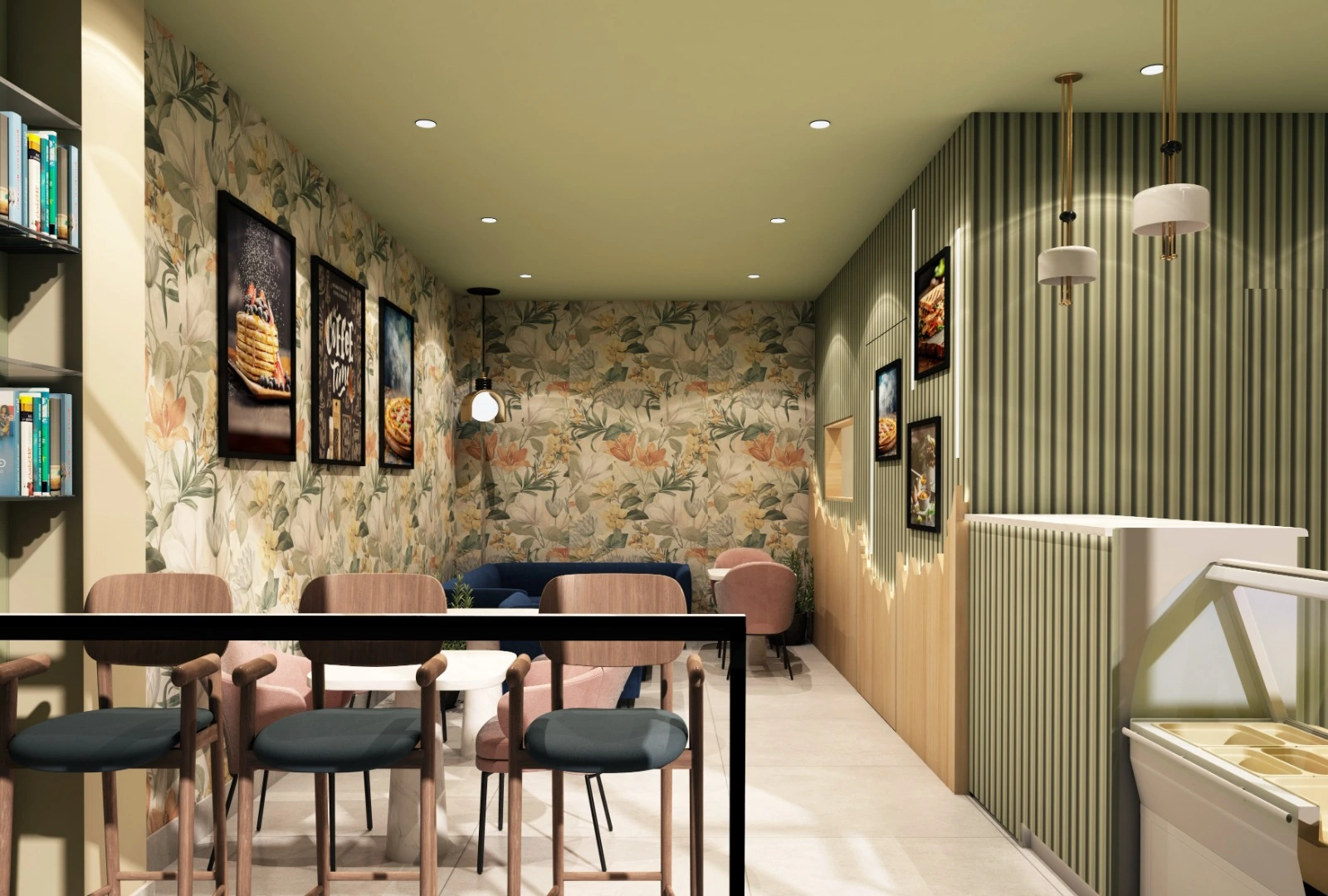
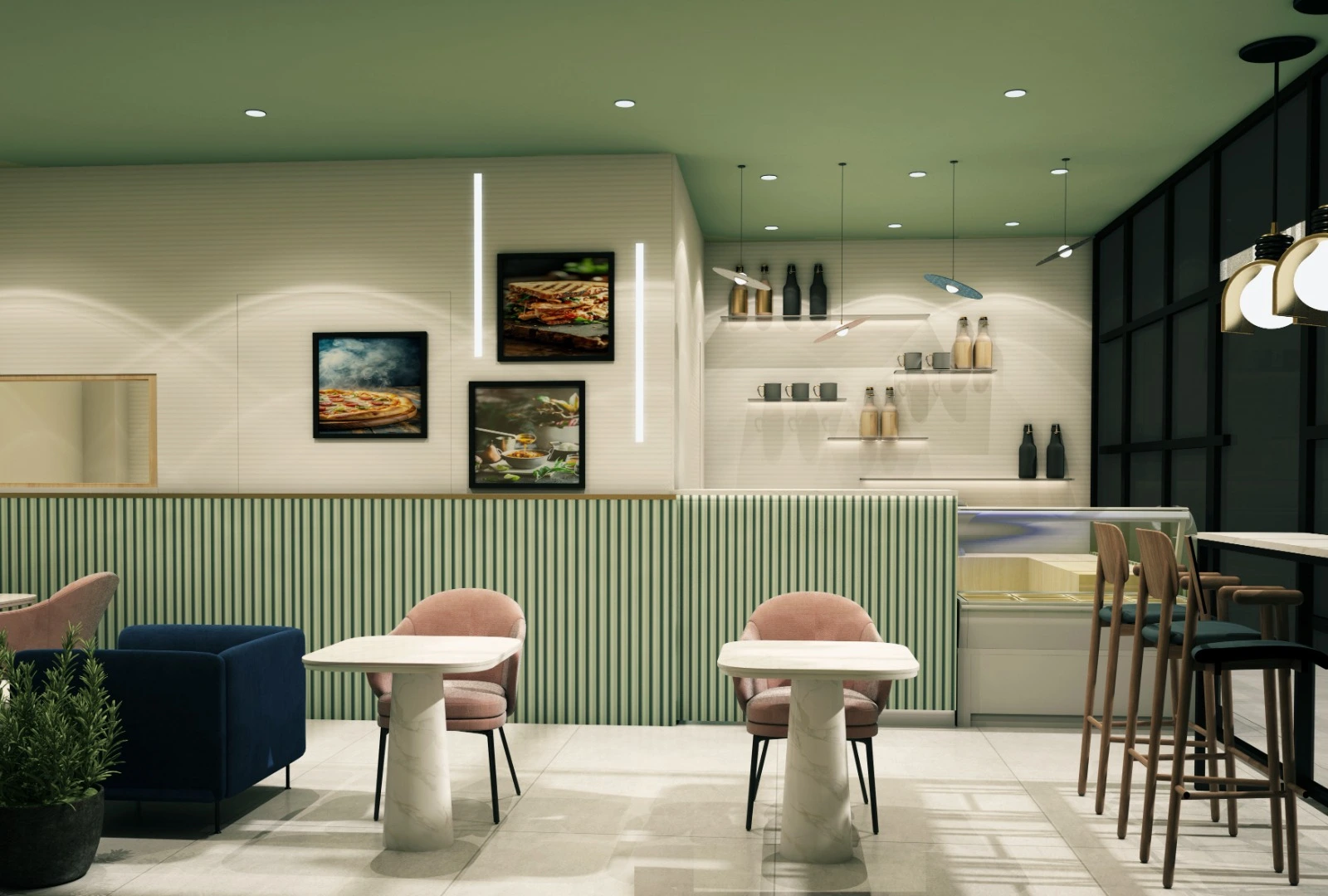
Pendant lights above key seating zones introduce intimacy and warmth at a human scale. Suspended at the right height, these fixtures bring the ceiling down psychologically, making a large commercial space feel personal and cosy rather than vast and impersonal. This is one of the most effective lighting design techniques for large commercial interiors, and it is executed beautifully here.
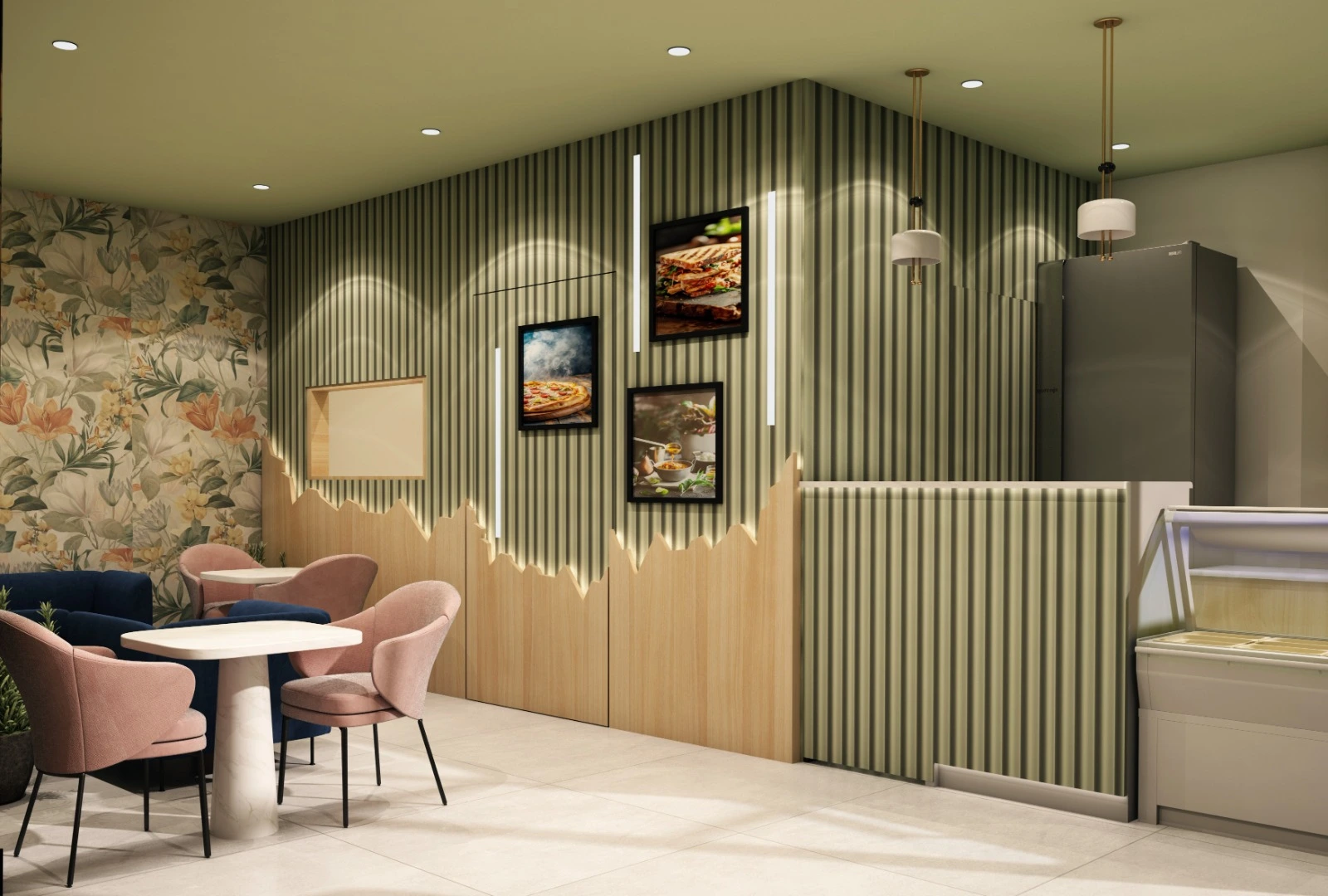
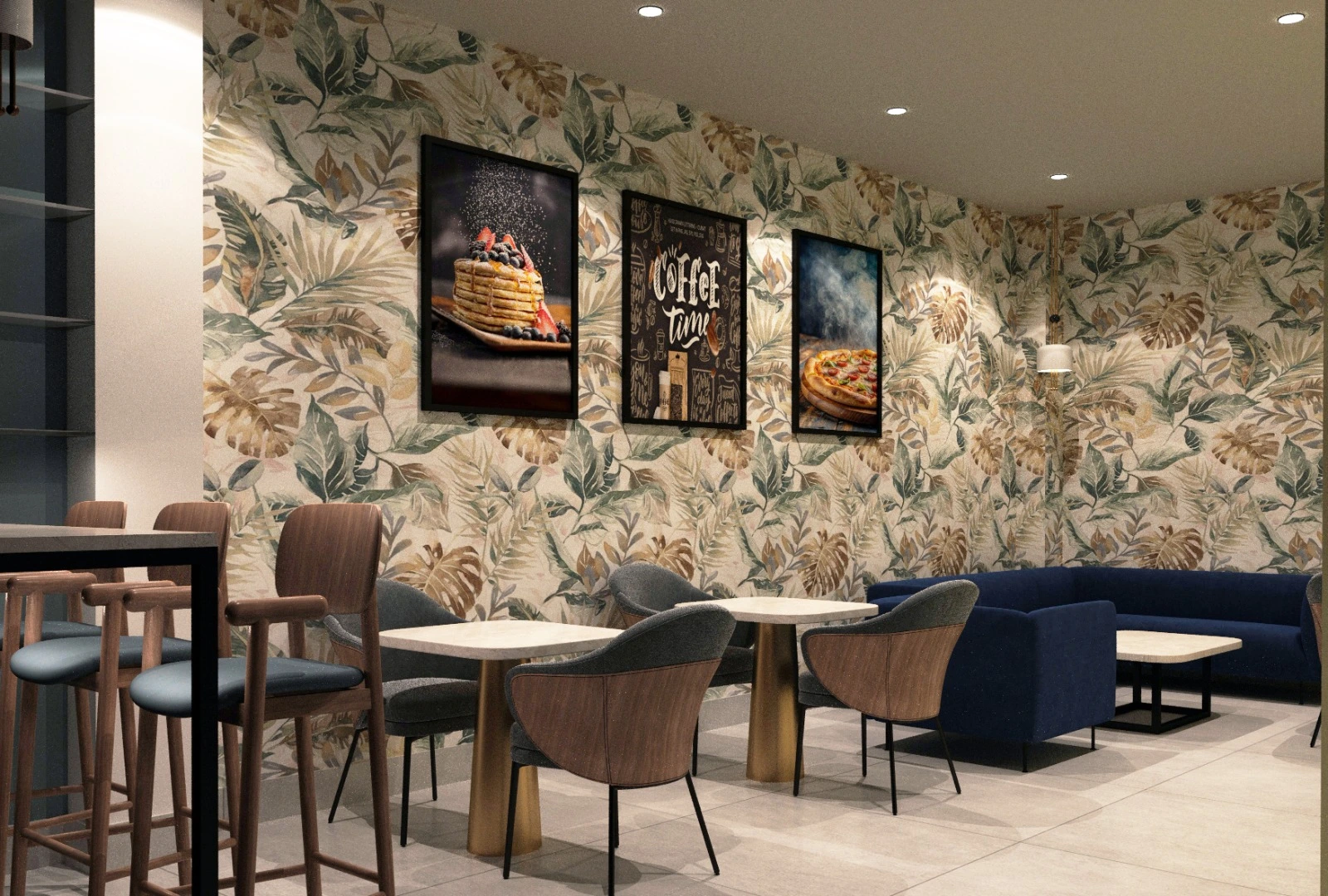
Accent lighting directed at feature walls, artwork, and architectural details creates the visual hierarchy that makes a space feel designed rather than simply furnished. These directional fixtures highlight the botanical feature wall, animate the food-themed artwork, and draw the eye to the most impactful design moments throughout the space.
The combined effect is an interior that transitions naturally from bright and energetic during peak daytime hours to warm and intimate during evenings — without any physical change to the space itself. This lighting adaptability is a significant commercial asset, allowing the same environment to serve different customer moods and different business needs across the full trading day.
Colour, Pattern & the Psychology of a Beautifully Designed Space
Colour selection in commercial interior design is not a matter of personal taste. It is a strategic decision informed by decades of research into how colours affect human psychology, emotional response, and behaviour in built environments.
The palette chosen for this project was built around four carefully considered tones, each selected for its specific psychological effect in a commercial setting.
Warm beige and ivory tones form the neutral foundation of the interior. These shades create a sense of calm, openness, and cleanliness — lowering perceived stress and providing the visual breathing space that busy commercial environments need to prevent sensory overload.
Olive green is one of the most strategically valuable colours in contemporary interior design. Earthy green tones activate associations with nature, health, and safety — responses that are deeply embedded in human psychology. Research consistently shows that green interiors reduce customer anxiety and increase the time people are willing to spend in a space. For any commercial environment where dwell time correlates with revenue, this is a commercially significant design choice.
Blush pink and dusty rose accents add warmth, softness, and a contemporary visual appeal that resonates strongly with today's consumers. These tones also carry a significant practical benefit in the age of social media — spaces with photogenic, soft-toned accents generate organic content from customers, creating a continuous stream of free visual marketing for the business. In modern commercial interior design, the photographable space is a revenue-generating asset.
Slate blue provides the depth and contrast that prevents a warm palette from becoming monotonous. Blue tones carry subconscious associations with trust, reliability, and quality — reinforcing brand credibility in a way that customers feel rather than consciously register.
Tying the entire palette together is the botanical wallpaper used on the hero feature wall — a design choice that goes well beyond decoration. This richly illustrated, nature-inspired wall treatment is a direct application of biophilic design principles, bringing the psychological benefits of nature into a built commercial environment. The organic movement of the botanical patterns softens the space, adds visual depth, and creates the kind of distinctive, memorable interior moment that customers remember and return for.
The Design Details That Complete the Experience
Great interior design is ultimately about the details — the choices that individually seem small but collectively create the difference between a space that feels ordinary and one that feels exceptional.
The food-themed framed artwork throughout this project does more than decorate walls. It reinforces the thematic identity of the space, communicates the brand's personality to every visitor, and creates visual interest at human eye level across the entire floor plan. Artwork in commercial spaces is not decoration — it is storytelling.
The vertical panelling on counter walls introduces sharp geometric structure that balances the softness of the botanical patterns and the warmth of the colour palette. This deliberate interplay between organic softness and architectural geometry gives the interior a visual sophistication — a sense that every element has been intentionally placed in conversation with every other.
The mix of seating typologies — plush lounge sofas, ergonomic upholstered chairs, and bar-height counter seating — is one of the project's most commercially intelligent design decisions. Different seating attracts different customer behaviours, and different customer behaviours serve different business needs. The solo morning visitor who wants a counter seat and a quick coffee coexists effortlessly with the afternoon group occupying a lounge corner for two hours. Both feel that the space was designed for them — because, in a very real sense, it was.
What This Project Teaches Us About the Future of Commercial Design
The most important lesson from this project is one that applies to every business considering a commercial interior investment, regardless of size, sector, or budget: design is not a cost. It is a strategy.
The businesses that are winning in today's competitive commercial landscape are not winning purely on product quality or pricing. They are winning on experience — on the feeling their physical environment creates the moment a customer crosses the threshold. They understand that a well-designed commercial interior does not just accommodate customers; it converts them into loyal ones.
This 31,215 sq. ft. project in Greater Noida demonstrates exactly how that conversion happens — through intelligent space planning, durable and beautiful material selection, layered lighting design, evidence-based colour psychology, and an unwavering commitment to the human experience of the space. It is a benchmark for what modern commercial interior design in Greater Noida and Delhi NCR can achieve when architecture, design, and construction intelligence work together from the very first decision.
For More Detail Visit - 🌐 https://architectshive.com/
📞 +91 75034 68992 | +91 99586 00397
✉️ contact@architectshive.com
📍 Serving: Ghaziabad | Noida | Greater Noida | East Delhi | West Delhi | North Delhi | South Delhi | Faridabad | Gurugram
#ArchitectureConsultancyInNoida #ArchitectureConsultancyInDelhiNCR #CommercialArchitecture #ArchitectFirmsNearMe #CommercialBuildingDesign #FacadeDesignNoida #VastuCommercialDesign #ArchitectsHive #NoidaCommercialArchitecture #ModernCommercialDesign #HouseDesign #HomeDesign #InteriorDesign #ModernHouseDesign #BestArchitectsInGreaterNoida #ArchitectsInDelhiNCR #HomeConstruction #ResidentialArchitecture #LuxuryHomeDesign #ContemporaryHouseDesign #SustainableArchitectureIndia #EcoFriendlyHomeDesign #CustomHomeDesign #VillaDesign #2BHKHouseDesign #3BHKHouseDesign #SmartHomeDesign #ArchitectureAndInteriorDesign #CompactHomeDesign #EnergyEfficientHome #InteriorDesignersInNoida #FullHomeInterior #ExteriorHomeDesign #MinimalistArchitecture #VastuCompliantHouseDesign #ArchitectsInAligarh #BestArchitectsInUP #IndependentHouseDesign #DoubleStoreyHouseDesign #ModernHomeConstruction #ResidentialInteriorDesign #ContemporaryArchitectureIndia #ArchitectsHive #BestArchitectureFirm #HireArchitectForHome #BestArchitectNearMe
Gallery