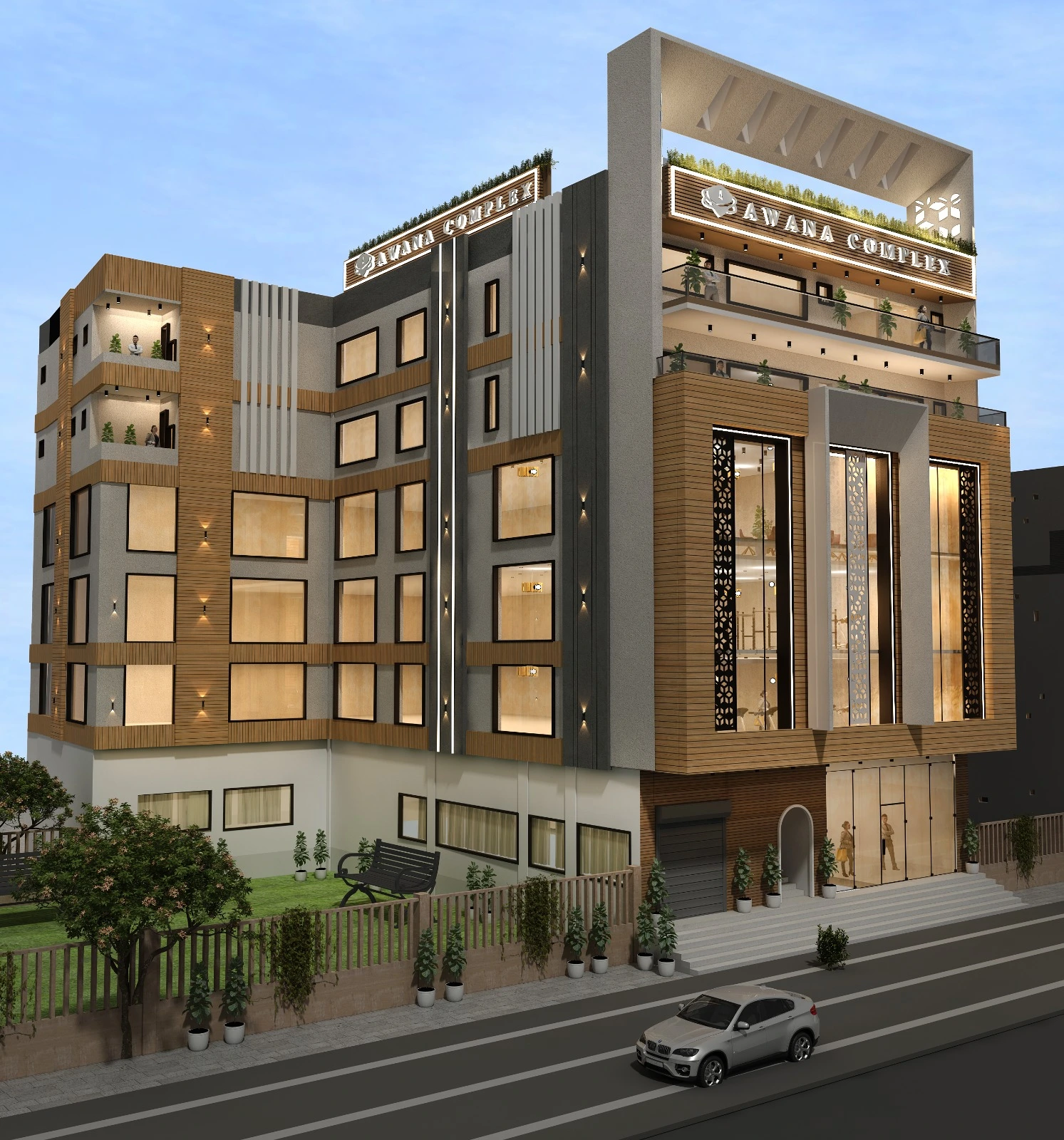
There's a moment every serious business owner in Noida eventually faces. The structure is built. The interiors are done. The signboard is up. And yet — something is off. Footfall is lower than expected. The space feels awkward. Customers leave faster than they should. The building looks like every other building on the block.
That moment is expensive. And it's almost always the result of one decision made too early and too casually: choosing the wrong architecture consultancy. According to a 2023 Knight Frank India report, commercial properties in Delhi NCR with superior design and architecture command rental premiums of up to 20–30% higher than generic developments in the same location. The building itself — how it looks, how it functions, how it makes people feel — is a direct financial variable.
If you're currently searching for architect firms near me or exploring architecture consultancy in Noida, this guide is written specifically for you. It will walk you through what high-performance commercial architecture looks like, what separates great consultancies from average ones, and why your building — if designed correctly — should be your single most powerful business asset.
The Commercial Architecture Problem No One Talks About
Delhi NCR is one of the fastest-growing commercial real estate markets in Asia. Noida alone has seen an explosion of corporate campuses, retail corridors, mixed-use developments, and premium commercial zones — particularly across sectors like 18, 62, 93, 94, 125, and 132. Between 2020 and 2024, over 12 million square feet of new commercial space was absorbed across the Noida–Greater Noida belt alone.
But here's the uncomfortable truth: most commercial buildings being constructed in this region are being under-designed. They're built to code. They're structurally sound. They meet the minimum requirements. But they're not designed to perform — commercially, visually, or spatially. This is the gap that a serious architecture consultancy in Noida is built to close.
The difference between a building that generates business and one that merely houses it comes down to decisions made at the design stage — decisions about orientation, facade composition, floor planning, material selection, lighting strategy, and the intelligent integration of principles like Vastu Shastra into modern spatial logic.
When those decisions are made well, the building works for you. When they're made poorly — or not made at all — the building works against you. And unlike a marketing campaign or a website redesign, a poorly designed building cannot be quickly corrected. It costs you every single day.
What High-Performance Commercial Architecture Actually Involves
When business owners search for commercial architecture services in India, they often focus on aesthetics — "I want it to look modern" or "I want a glass facade." These are valid starting points. But the most successful commercial buildings are built on a far more comprehensive foundation.
Here is what genuinely effective commercial architecture looks like across five dimensions:
1. Strategic Floor Planning — Designing for How Business Actually Moves
Every commercial building serves a different kind of human movement. Retail spaces need to guide customers toward product. Office buildings need to separate collaborative zones from focused work areas. Hospitality venues need to create mood through spatial transition.
A skilled architecture consultancy in Delhi NCR begins every commercial project not with aesthetics but with use analysis — understanding who will be in this building, what they will be doing, how they will move, and what spatial experiences will drive the outcomes the client is after.
This translates into intelligent, floor-by-floor zoning:
Ground Floor is designed for maximum visibility, footfall, and brand exposure — with large glazing, open planning, and a welcoming entrance that commands attention from the street. This floor has the highest commercial conversion potential and must be treated accordingly.
Mid-Level Floors are planned with grid-based, adaptable layouts suited for offices, clinics, consultation suites, or service centres — flexible enough to accommodate multiple tenants or evolving business types without requiring structural changes.
Top Floor is designed as a premium tier — with terrace access, extended balcony zones, enhanced natural light, and the kind of open-air character that supports cafes, creative studios, or executive spaces. Height, in commercial architecture, is a premium feature — and it should be designed to feel like one.
When floor planning is done this way — purposefully, level by level — the result is a building that supports business activity rather than constraining it. Buildings that skip this analysis end up with floors that feel wrong for every use case, because no specific use case was ever considered.
2. Facade Design — Your Permanent, 24-Hour Marketing Tool
If you've ever searched architect firms near me specifically for commercial elevation work, you already understand something important: the facade is not decoration. It is communication.
Before a single customer steps through your door, before anyone reads your signage, before your staff greets a visitor — your building's exterior has already made a statement. It has either said "this is a serious, credible operation" or it has said something considerably less flattering. Research in consumer psychology consistently shows that this judgment is made within the first 90 milliseconds of visual exposure.
Modern commercial facade design in the Delhi NCR region relies on a sophisticated vocabulary of materials and proportions:
Glass brings transparency and openness. Large commercial glazing invites the street in, creates a sense of accessibility, and floods interiors with natural light — reducing energy costs while meaningfully enhancing the quality of the commercial environment.
Metal panels and geometric elements communicate precision, modernity, and structural confidence. Used well, they give a commercial building the kind of architectural authority that supports premium brand positioning.
Natural textures — wood cladding, stone accents, textured plaster — introduce warmth and human scale. They prevent commercial facades from feeling cold or institutional and signal a level of craft and investment that customers register subconsciously.
Layered depth is perhaps the single most important quality of a high-performing facade. Flat surfaces look cheap and dated. Facades with recesses, projections, material transitions, and strategic shadow play create visual richness that catches attention and holds it throughout the day as light conditions change.
The best commercial architecture firms in Noida also understand that a facade must work after dark. Exterior lighting — strip lights along vertical fins, cove lights embedded in facade grooves, warm backlighting through textured cladding — must be planned from the beginning, not bolted on as an afterthought. A building that looks distinctive at noon and dramatic at midnight is a building doing its commercial job around the clock, 365 days a year.
3. Vastu Integration — Ancient Spatial Logic Meets Modern Design
Here is a perspective that surprises many business owners when they first hear it: Vastu Shastra, intelligently applied, is not in conflict with modern commercial architecture. It is an ancient system built on many of the same principles.
The misunderstanding arises from treating Vastu as a rigid checklist of dos and don'ts, divorced from design logic. When a reputable architecture consultancy in Delhi NCR integrates Vastu into a commercial project, something far more nuanced is happening — traditional spatial wisdom is being used as a lens through which to evaluate orientation, circulation, natural element access, and the psychological comfort of occupants.
Vastu-aligned commercial design practically produces:
Entry orientation that welcomes natural energy flow — meaning an entrance that is unobstructed, well-lit, and positioned to create a positive first spatial experience for every visitor, right from the moment they approach the building.
Directional zoning of functional areas — separating customer-facing spaces from service and utility areas in ways that prevent operational friction from bleeding into the commercial environment.
Proportionate placement of staircases, ventilation, and openings — ensuring that vertical and horizontal circulation serves the building's functional balance while maximising everyday usability.
Symmetrical massing and front-facing glazing — creating a facade that is architecturally coherent and aligned with principles of structural balance that both traditional wisdom and modern engineering endorse.
For business owners across Noida and Delhi NCR, Vastu-integrated commercial design is increasingly a deliberate choice — not because it is traditional, but because buildings designed with this kind of holistic spatial thinking consistently feel better to occupy. And spaces that feel better drive measurably better commercial outcomes.
4. Material Intelligence — Choosing for Performance, Not Just Appearance
One of the clearest markers of a high-quality architecture consultancy in Noida is how they approach material selection. Poor consultancies choose materials for how they look in a render. Great ones choose materials for how they perform across a ten-year lifespan in the specific climate, usage pattern, and maintenance context of your building.
For commercial buildings in Delhi NCR — which must withstand extreme summer heat regularly exceeding 45°C, monsoon moisture, high urban dust loads, and heavy daily usage — the material palette demands environmental intelligence:
Exterior laminates and composite panels engineered for weather resistance and low maintenance are critical in high-pollution urban environments where surfaces degrade quickly without the right protection.
High-performance glass with thermal insulation properties reduces cooling loads and energy costs significantly — an increasingly important consideration as Delhi NCR's commercial energy costs rise year on year.
Designer metal jaali patterns add architectural depth and allow natural ventilation while creating a contemporary character that distinguishes a building from its generic neighbours.
Professional tonal ranges — greys, beiges, warm off-whites — maintain their visual quality over time and resist the grime and discolouration that darker or heavily saturated palettes accumulate rapidly in urban conditions.
Material intelligence does not show up in photorealistic renders. It shows up in your maintenance bills, in your building's appearance five years after completion, and in the trust that tenants and customers place in the permanence and quality of your commercial space. It is the difference between a building that looks as good at year eight as it did at year one — and one that doesn't.
5. Future-Readiness — Building for the Business You Don't Have Yet
India's Tier-1 commercial landscape changes faster than almost anywhere else in the world. A showroom becomes a co-working space. A restaurant becomes a wellness centre. A retail outlet becomes a medical clinic. Buildings designed around a single, inflexible use case become commercially obsolete the moment that use case changes — and in today's business environment, that moment arrives sooner than most owners expect.
The most sophisticated commercial architecture firms in Delhi NCR design for adaptability. Structurally, this means spans that avoid load-bearing walls in business-critical positions. Mechanically, it means flexible utility runs that can be reconfigured without major structural intervention. Dimensionally, it means floor plates sized and proportioned to accommodate a wide range of commercial tenants without feeling either cramped or oversized.
Buildings designed this way remain commercially viable across multiple business cycles. They attract a broader range of tenants. They hold their value in ways that rigidly designed buildings simply cannot. And they give their owners strategic options — the ability to respond to market shifts rather than being trapped by construction decisions made a decade earlier.
How to Choose the Right Architecture Consultancy in Delhi NCR
If you are currently evaluating architect firms near me for a commercial project, here is a sharper evaluation framework than simply browsing portfolios:
Ask specifically about commercial experience. Residential and commercial architecture, while related, require entirely different thinking. Commercial design must account for footfall patterns, brand identity expression, tenant flexibility, regulatory compliance, and commercial floor efficiency in ways residential design never encounters. Ask your prospective consultancy how many commercial projects they have completed, at what scale, and in what business categories.
Evaluate their planning process, not just their design output. Great architecture begins with rigorous analysis — site orientation, use case planning, Vastu assessment, material specification for the specific location and climate. Ask how a firm approaches the pre-design phase. A consultancy that goes straight to renders without a structured planning process will produce beautiful visuals and disappointing buildings.
Look for holistic, end-to-end consultancy. The best outcomes come from firms that remain engaged from concept through construction — catching deviations from design intent, advising on material substitutions, maintaining quality standards through execution. Always ask whether site supervision is included in the consultancy scope, or whether designs are handed off and the firm disappears.
Verify genuine Vastu expertise. If Vastu integration matters for your project — and for most commercial projects in Delhi NCR, it does — confirm that the firm understands Vastu as a spatial system, not a compliance checklist. Ask them to walk you through how they integrate Vastu logic into floor planning decisions for commercial typologies.
Ask about completed buildings, not just renders. Every firm has compelling 3D elevations in their portfolio. Ask to see finished buildings — and if possible, visit one. The gap between a photorealistic render and a well-executed commercial building is precisely where most firms reveal their true capabilities.
Why Noida Specifically Demands Architectural Seriousness
Among Delhi NCR's commercial corridors, Noida has undergone the most dramatic architectural evolution of the past decade. The Noida Expressway belt, the knowledge park zones, the Film City corridor, and the emerging precincts of sectors like 93, 94, and 132 now sit alongside some of the most architecturally sophisticated commercial developments in North India.
This context matters enormously for anyone planning a new commercial building in the region.
When your building exists in proximity to premium corporate campuses, international hospitality developments, and technology sector headquarters, it is evaluated in direct comparison to those neighbours — by prospective tenants, by customers, by investors, and by the market at large. A building that falls architecturally below its context loses commercial value immediately, regardless of how strategically located it might be.
This is why businesses across Noida are increasingly seeking serious architecture consultancy in Noida — not merely to build something functional, but to build something that holds its own in a market where the architectural bar rises with every new development. The commercial buildings being designed today will define the city's commercial identity for the next two decades. The businesses and developers investing in architectural quality right now are not just building structures. They are building long-term commercial assets that will compound in value as Noida's premium commercial reputation continues to grow.
The ROI Argument for Serious Commercial Architecture
The financial case for investing in quality architecture consultancy in Delhi NCR deserves to be made directly and specifically.
A well-designed commercial building in a competitive market like Noida commands rental premiums of 20–30% over generic alternatives in the same location — not because tenants are paying for aesthetics, but because well-designed spaces are more productive, more attractive to end customers, and more representative of the brand identities that serious tenants work hard to cultivate.
Vacancy periods are consistently shorter for architecturally distinctive commercial spaces. A building that stands out in its market leases faster, attracts better-qualified tenant inquiries, and requires less incentivisation to fill. Over the holding period of a commercial asset, this difference in vacancy performance alone can exceed the entire cost of the original architectural investment.
Long-term maintenance costs are substantially lower when material selection has been made intelligently. Buildings specified for the Delhi NCR climate — with weather-resistant cladding, thermally-performing glass, and low-maintenance surface finishes — cost meaningfully less to maintain at year five and year ten than buildings where materials were chosen for render appeal rather than real-world durability.
And for owner-operated businesses, there is a form of brand equity that no marketing budget can replicate: the permanent, daily, zero-incremental-cost statement that a well-designed building makes to every person who walks past it, drives past it, or sees it in a photograph. A building that looks like your brand — that expresses your values through its architecture — builds unconscious trust at a scale and consistency that advertising simply cannot achieve.
Against all of these returns, the cost of engaging a serious architecture consultancy in Delhi NCR is not an overhead expense. It is the highest-returning investment most commercial property owners will ever make.
Frequently Asked Questions
Q: How much does architecture consultancy in Noida typically cost for a commercial project? Architecture consultancy fees in Noida for commercial projects typically range from 3% to 8% of the total construction cost, depending on the scope of services, project size, and whether the consultancy includes execution supervision. End-to-end consultancies — covering planning, design, elevation development, and site supervision — sit toward the higher end of this range and consistently deliver better outcomes than design-only engagements.
Q: How long does the architecture consultancy process take before construction can begin? For a standard multi-floor commercial project, a thorough consultancy process — including site analysis, floor planning, Vastu assessment, 3D elevation development, and material specification — typically takes 6 to 12 weeks. Rushing this phase to save time almost always costs more time and money during construction.
Q: Is Vastu really important for commercial buildings in Delhi NCR? For the majority of commercial projects in Delhi NCR, Vastu-aligned design is both culturally significant and practically beneficial. When integrated intelligently by an experienced architecture consultancy — rather than applied as a rigid checklist — Vastu principles consistently produce buildings with better spatial flow, more intuitive circulation, and stronger occupant comfort. These qualities have direct commercial implications.
Q: What is the difference between a residential architect and a commercial architect firm? Commercial architect firms specialise in buildings designed for business use — retail, office, hospitality, mixed-use developments. Their expertise covers footfall planning, brand identity expression through architecture, commercial floor efficiency, multi-tenancy adaptability, and regulatory compliance for commercial occupancy. These are entirely different skill sets from residential design, and commercial projects handled by residential-focused firms routinely underperform commercially as a result.
Q: How do I find the best architect firm near me for a commercial project in Noida? Start by searching for firms with a documented portfolio of completed commercial buildings — not just renders — in the Delhi NCR market. Prioritise consultancies that offer end-to-end service including site supervision. Ask to visit a completed project before committing. And always ask specifically about their approach to Vastu integration, material specification for the Delhi NCR climate, and adaptable floor planning. The answers to these questions will tell you more than any portfolio.
Conclusion: Choose Architecture That Works as Hard as You Do
Commercial architecture at its best is not about beautiful buildings. It is about buildings that perform — that attract customers, support tenants, express brand identity, hold their value, and adapt to whatever the next decade of business demands.
Finding the right architecture consultancy in Noida or across Delhi NCR means finding a partner who thinks about your building the way you think about your business — strategically, rigorously, and with a clear eye on the long-term outcomes. It means working with a firm that brings the same level of commercial intelligence to your building that you bring to your business every day.
Whether you are developing a ground-up commercial complex, upgrading an existing facade, or planning a multi-floor commercial building for mixed business use — the decisions made at the design stage will determine what your investment returns for the next twenty years.
Build with intention. Build with expertise. Build with an architecture consultancy in Delhi NCR that understands what your building needs to do — not just what it needs to look like.
Ready to start planning your commercial project in Noida or Delhi NCR? ArchitectsHive is a full-service architecture consultancy specialising in high-performance commercial design across the Delhi NCR region. Our team brings together contemporary architectural expertise, Vastu-integrated planning, and a deep understanding of how built environments drive business outcomes. Get in touch to schedule your initial consultation.
#ArchitectureConsultancyInNoida #ArchitectureConsultancyInDelhiNCR #CommercialArchitecture #ArchitectFirmsNearMe #CommercialBuildingDesign #FacadeDesignNoida #VastuCommercialDesign #ArchitectsHive #NoidaCommercialArchitecture #ModernCommercialDesign #HouseDesign #HomeDesign #InteriorDesign #ModernHouseDesign #BestArchitectsInGreaterNoida #ArchitectsInDelhiNCR #HomeConstruction #ResidentialArchitecture #LuxuryHomeDesign #ContemporaryHouseDesign #SustainableArchitectureIndia #EcoFriendlyHomeDesign #CustomHomeDesign #VillaDesign #2BHKHouseDesign #3BHKHouseDesign #SmartHomeDesign #ArchitectureAndInteriorDesign #CompactHomeDesign #EnergyEfficientHome #InteriorDesignersInNoida #FullHomeInterior #ExteriorHomeDesign #MinimalistArchitecture #VastuCompliantHouseDesign #ArchitectsInAligarh #BestArchitectsInUP #IndependentHouseDesign #DoubleStoreyHouseDesign #ModernHomeConstruction #ResidentialInteriorDesign #ContemporaryArchitectureIndia #ArchitectsHive #BestArchitectureFirm #HireArchitectForHome #BestArchitectNearMe
For More Detail Visit - 🌐 https://architectshive.com/
📞 +91 75034 68992 | +91 99586 00397
✉️ contact@architectshive.com
Gallery