Imagine you are a mother from a small town in West Champaran, Bihar. Your child has been running a fever for three days — not the kind that breaks overnight with rest and water, but the kind that keeps climbing, the kind that makes you sit awake at 2 a.m. pressing your palm to a small forehead and feeling helpless.
You have tried the local clinic. You have tried the medicines they gave you. Nothing is working. Now you face a choice that no parent should ever have to make — pack your bags, borrow money you don't have, and take an exhausting overnight journey to Patna or Delhi, leaving behind everything familiar, or find real, trustworthy, world-class care right here, closer to home, closer to everything you know.
For generations, families in Bettiah have lived with the quiet, painful truth that good healthcare in Bihar meant going somewhere else. That quality medical care was a privilege that belonged to bigger cities and bigger bank accounts.
For too long, that choice didn't really exist. But it does now. And it exists because someone decided that this community deserved better — and then actually built it.
A City That Was Ready for Something Better
Bettiah is not a place that makes national headlines very often. Tucked into the northwestern edge of Bihar, close to the Nepal border, it is a city of roughly 130,000 people — hardworking, growing, and for years, quietly underserved when it came to quality healthcare infrastructure in Bihar.
Like hundreds of similar cities across India, Bettiah had medical facilities. What it lacked was a medical destination — a place that combined genuine clinical capability with an environment that made patients feel like human beings, not case numbers. This is the gap that defines healthcare facility design in India at its worst — and the gap that this project set out to close.
That gap is exactly what inspired this project. When Mr. Sharma approached ArchitectsHive — one of the best architecture firms in India specialising in healthcare — with his vision for a world-class hospital in Bettiah, he wasn't just commissioning a building. He was making a statement about what his community deserved.
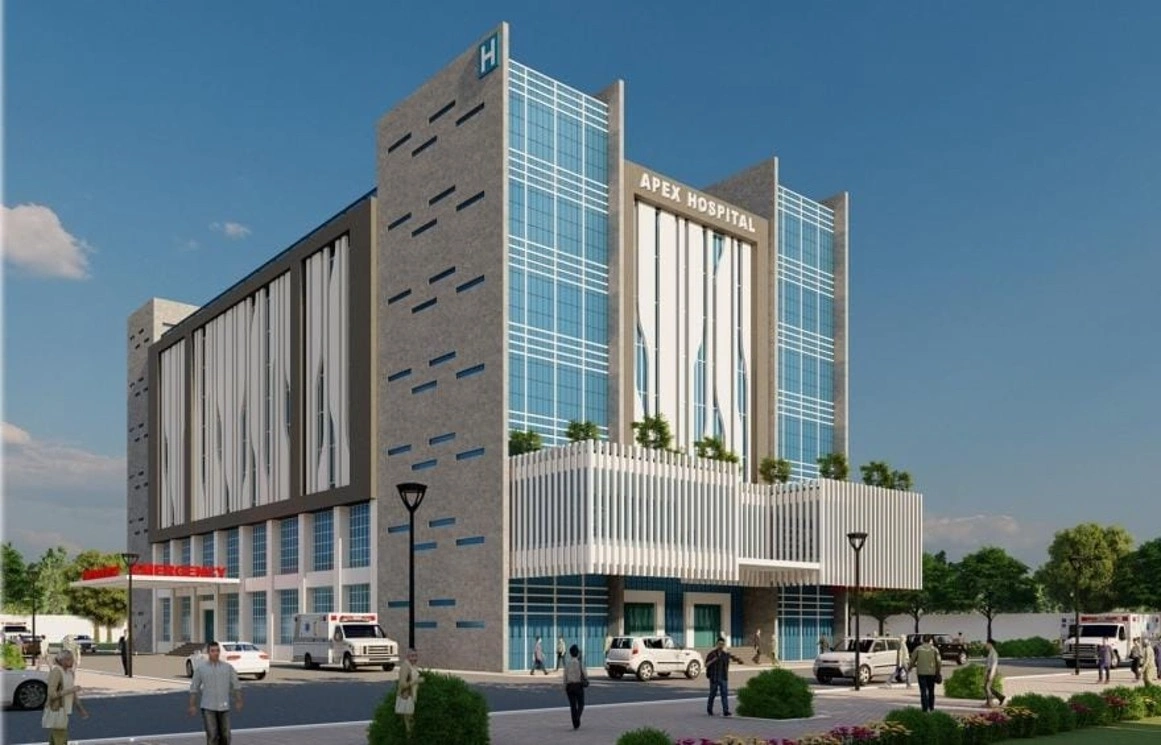
And ArchitectsHive took that responsibility seriously from day one. What followed was a design journey that would produce one of the most compelling examples of modern hospital architecture in India: a 61,891 sq. ft. healthcare facility in Bettiah, Bihar that doesn't just treat illness — it actively supports healing.
The Question That Changed Everything
Most architects, when given a hospital design in India brief, begin with a floor plan. ArchitectsHive began with a question:
"What does a patient actually feel when they walk into a hospital?"
It sounds simple. But sit with it for a moment, and you realise how rarely that question gets asked — and how profoundly it should shape every decision that follows.
Think about the last time you visited a hospital. The harsh overhead lighting that made everyone look unwell. The corridors that seemed to go on forever with no landmark to orient yourself. The waiting areas that felt more like holding rooms than human spaces. The absence of windows. The absence of warmth. The sense that the building itself was indifferent to your suffering.
Now imagine the opposite. Imagine walking into a hospital and feeling your shoulders drop slightly. Where the light is natural and the air is fresh. Where the space feels organised but not oppressive. Where the environment says, quietly but clearly:
"You are going to be okay here."
That is what ArchitectsHive set out to build in Bettiah. And that single question — what does a patient feel? — became the compass that guided every decision in this patient-centered hospital design from the ground up.
How Does Hospital Design Affect Patient Recovery? Here Is What the Science Says
How does hospital design affect patient recovery? It is one of the most important questions in modern healthcare architecture — and the answer is more powerful than most people realise.
Research published in major medical journals over the past two decades has established something remarkable: the physical environment of a hospital directly affects clinical outcomes. The architecture of a hospital is not decoration — it is infrastructure for recovery. This is the foundation of evidence-based healthcare facility design in India and around the world.
Here is what the research shows:
- Natural daylight reduces pain perception and lowers the need for pain medication in recovering patients. This is why natural light in hospital design is no longer optional — it is clinical.
- Natural ventilation measurably reduces airborne infection rates in hospital wards.
- Views of green spaces and open sky lower cortisol — the body's primary stress hormone — within minutes of exposure.
- Acoustic design improves sleep quality during recovery, and sleep is one of the most powerful healing tools medicines has.
ArchitectsHive built this understanding into the bones of the Bettiah hospital project. Strategically placed courtyards open the building's interior to natural sky and light. Glazed corridors catch the morning sun, turning what could be dead transition spaces into moments of calm and orientation.
The passive ventilation system — carefully modelled to Bihar's climate — keeps air moving through wards and public areas without mechanical intervention, maintaining the kind of freshness that no air conditioning system can fully replicate.
Every window was placed with purpose. Every courtyard was sized for the light it would deliver at different times of day. This is what separates thoughtful healthcare facility design in India from construction that merely meets code.
The Floor Plan Is a Story
Every building tells a story through its layout. The question is whether it's a story anyone would want to live in. At 61,891 square feet, this hospital in Bettiah, Bihar had the rare gift of genuine space — room to plan generously rather than defensively. ArchitectsHive, as a leading architecture firm in Bihar, used every square foot deliberately.
The logic of the layout is almost conversational once you understand it:
- Emergency zones are positioned for immediate access — close to the entrance, with direct routes to critical care and no obstacles, no confusion.
- Outpatient areas are organised to handle high volumes of daily visitors without creating the gridlock that makes many Indian hospital lobbies feel overwhelming.
- Inpatient wards — where recovering patients need quiet and continuity — are placed furthest from activity, buffered by the building's own mass.
- Diagnostic zones sit at the intersection of both worlds: accessible to the clinical team without disturbing patient rest.
- Barrier-free design throughout ensures ease of movement for patients with mobility challenges — non-negotiable in truly inclusive healthcare architecture in Bihar.
The flow between these zones is where the real design thinking lives. In a poorly planned hospital, a nurse can walk two kilometres in a single shift, zigzagging between departments that should be neighbours. In a well-planned one, the same work happens in half the distance — which means faster response times, less fatigue, and better care for patients.
This is what world-class hospital planning in India looks like at the functional level: not just rooms arranged on a floor, but a system designed around the people who use it every single day.
Waiting Rooms That Respect Your Humanity
Here is something rarely discussed in conversations about hospital interior design in India: the waiting room is where most people spend most of their time in a hospital. Not in a procedure. Not in a consultation. Waiting.
And yet the waiting room is typically where the least design attention goes — a few rows of plastic chairs, a television mounted too high, fluorescent lights humming overhead, and the anxiety that comes from being in a space that communicates we didn't really think about you.
The team at ArchitectsHive refused to accept this. In this modern hospital design in Bihar, waiting areas have been designed with the seriousness they deserve:
- Seating is varied — individual chairs, family groupings, and quieter nooks for those who need a private moment apart from the crowd.
- Daylighting floods in from multiple angles, reducing the claustrophobic weight that defines most hospital waiting room designs in India.
- Acoustic design reduces ambient noise — a detail that makes a profound difference to anyone who has spent hours in a loud, echoing space worrying about someone they love.
- Warm natural textures and finishes replace the cold hard surfaces of conventional healthcare facility design, making the space feel welcoming rather than institutional.
This isn't luxury. It's dignity. And dignity, in a moment of fear and vulnerability, is exactly what people need.
A Facade That Communicates Before You Enter
In healthcare architecture, the exterior of a building performs a critical psychological function. A hospital's facade must communicate competence, care, and trustworthiness to a patient who may be arriving in their most vulnerable moment.
The exterior design of this hospital in Bettiah, Bihar achieves this with restraint and confidence. A composition of glass, natural stone, and high-performance composite cladding creates a visual language that feels contemporary without being cold — ambitious without being alienating. The building does not shout. It reassures.
For communities in Bihar — where quality healthcare infrastructure has historically been accessible only through expensive travel to Patna, Delhi, or beyond — this visual confidence carries real meaning. Before a word is spoken, before a single staff member is met, the building itself delivers a message to everyone who approaches it:
"You deserve this."
What Makes Good Hospital Interior Design in India? This Is the Answer
What makes a good hospital interior design in India? Walk into the Bettiah hospital, and the answer becomes immediately clear.
The hospital interior design here replaces the standard clinical palette — whites, greys, and institutional green — with a considered system of warm tones, natural material textures, and purposeful art placements. Soft neutrals in patient wards create a sense of calm. Richer accents in public areas and reception zones communicate vitality and welcome.
Each clinical zone — from consultation rooms and diagnostic areas to procedure suites and operation theatres — has been planned with ergonomic precision. Material selections balance durability, ease of cleaning, and infection-control standards without defaulting to the cold, hard surfaces that make so many hospital interiors in India feel hostile.
This is patient-centred interior design taken seriously: not as a branding exercise, but as a genuine clinical commitment to the well-being of every person who enters.
Green by Design: Sustainable Hospital Design That Serves People
Sustainable hospital design in India is sometimes presented as a trade-off — you do the right thing for the environment, but it costs more, or it compromises something else. This project proves that framing wrong.
- Solar energy systems reduce grid dependency and cut long-term operational costs — freeing financial resources that can be redirected toward better patient care.
- Rainwater harvesting infrastructure captures and recycles precipitation for non-potable use, reducing pressure on Bettiah's municipal water supply.
- Passive design strategies — optimised building orientation, strategic shading, and high-performance glazing — minimise thermal load across Bihar's demanding seasonal range.
- Provisions for smart upgrades mean the building can adopt energy-efficient systems and green hospital technologies as they become available.
Sustainable hospital design and cost-efficient hospital operation are not competing priorities. They are, when done correctly, the same priority. A hospital that takes environmental responsibility seriously also sends a deeper message to its community: we are invested in the long term. We are building something that will still serve your grandchildren. That kind of institutional commitment to the future is itself a form of care.
Built for Tomorrow, Open Today: Future-Ready Hospital Architecture in India
Healthcare is changing faster than almost any other sector. Telemedicine, AI-assisted diagnosis, electronic health records, robotic-assisted surgery — technologies that were experimental a decade ago are rapidly becoming standard practice. A hospital built today must be ready for all of it. This is the defining challenge of future-ready hospital architecture in India.
The Bettiah facility integrates smart hospital infrastructure from the ground up: digital facility management systems, emergency response frameworks, and patient data platforms designed for the connected healthcare landscape India is rapidly moving toward.
Crucially, the building's physical infrastructure has been designed with flexibility in mind. When new technologies emerge — and they will — this modern hospital in Bihar can adapt without costly reconstruction. The investment made today is protected for decades to come. This is what future-ready hospital design in India looks like: not just a building that meets today's standards, but one that anticipates tomorrow's needs.
This Is Bigger Than One Hospital
India is currently building healthcare infrastructure at a scale and pace not seen since independence. Hundreds of new hospitals, clinics, and health centres are being planned and constructed across the country every year — many of them in exactly the kind of tier-2 and tier-3 cities that Bettiah represents.
What makes a good hospital design in India?
How those buildings are designed will shape the experience of illness, recovery, and healthcare delivery for hundreds of millions of Indians over the next half century. The choices being made right now — about natural light and ventilation, about waiting room dignity and circulation flow, about sustainable hospital design and smart infrastructure — will either elevate Indian healthcare or simply replicate its historical shortcomings in newer buildings.
The hospital in Bettiah, Bihar is a proof of concept for getting those choices right. It demonstrates, concretely and compellingly, that world-class hospital design in India is not a metropolitan privilege. It is achievable in any city, for any community, when the right priorities are in place from the start.
ArchitectsHive — one of the best architecture firms in India for healthcare — has built that demonstration in 61,891 square feet of inhabited evidence. Every corridor, every courtyard, every carefully oriented window is part of the argument.
The Architecture of Trust
Return, for a moment, to that mother from the small town in West Champaran. She walks into the hospital in Bettiah. The light is warm and natural. The space is calm and clear. She can find her way without asking for help. The waiting area has a seat near a window, and through it she can see a courtyard with open sky.
She is still frightened for her child. She may be frightened for a while yet. But something in the building itself reassures her. Quietly, without a word being spoken, the space communicates: this is a serious place. Careful people work here. You are in good hands.
That communication — that architecture of trust — is the most powerful thing a hospital design can offer. And it is, ultimately, what ArchitectsHive built in Bettiah. Not just a healthcare facility in Bihar. A place where Bihar comes to heal.
About ArchitectsHive
ArchitectsHive is not just another architecture and interior design firm in India. It is a firm that begins every project with a question most firms never ask — who is this space really for, and what do they deserve?
Founded on the belief that great design is not a luxury reserved for the privileged few, ArchitectsHive has spent years quietly reshaping how India thinks about its built environment — one thoughtfully considered project at a time. From world-class healthcare facilities and warmly designed homes to commercial spaces that inspire and institutional buildings that serve, every project that leaves the firm carries the same invisible signature: intelligence in planning, empathy in execution, and a refusal to treat any community as less deserving than another.
Their work spans healthcare architecture, residential, commercial, and institutional design across India, but it is in healthcare that their philosophy finds its most powerful expression. Because nowhere does hospital design in India matter more than in a place where people arrive frightened, vulnerable, and in need of something that goes far beyond medicine — they need to feel safe. They need to feel seen. They need an environment that quietly tells them: you are in the right place.
The hospital in Bettiah, Bihar is perhaps the clearest proof yet of what ArchitectsHive stands for. In a city that the mainstream architecture world might have overlooked, this best architecture firm in India chose to bring its full attention, full creativity, and full conviction. The result is a 61,891 sq. ft. landmark of modern hospital architecture in India that doesn't just serve its community — it honours it.
Because at ArchitectsHive, design excellence and social purpose have never been competing priorities. They have always been, and will always remain, the same thing.
📍 Serving: Ghaziabad | Noida | Greater Noida | East Delhi | West Delhi | North Delhi | South Delhi | Faridabad | Gurugram
✨ Your home is more than a building. Let's design something worth living in.
#ArchitectureConsultancyInNoida #ArchitectureConsultancyInDelhiNCR #CommercialArchitecture #ArchitectFirmsNearMe #CommercialBuildingDesign #FacadeDesignNoida #VastuCommercialDesign #ArchitectsHive #NoidaCommercialArchitecture #ModernCommercialDesign #HouseDesign #HomeDesign #InteriorDesign #ModernHouseDesign #BestArchitectsInGreaterNoida #ArchitectsInDelhiNCR #HomeConstruction #ResidentialArchitecture #LuxuryHomeDesign #ContemporaryHouseDesign #SustainableArchitectureIndia #EcoFriendlyHomeDesign #CustomHomeDesign #VillaDesign #2BHKHouseDesign #3BHKHouseDesign #SmartHomeDesign #ArchitectureAndInteriorDesign #CompactHomeDesign #EnergyEfficientHome #InteriorDesignersInNoida #FullHomeInterior #ExteriorHomeDesign #MinimalistArchitecture #VastuCompliantHouseDesign #ArchitectsInAligarh #BestArchitectsInUP #IndependentHouseDesign #DoubleStoreyHouseDesign #ModernHomeConstruction #ResidentialInteriorDesign #ContemporaryArchitectureIndia #ArchitectsHive #BestArchitectureFirm #HireArchitectForHome #BestArchitectNearMe
For More Detail Visit - 🌐 https://architectshive.com/
📞 +91 75034 68992 | +91 99586 00397
✉️ contact@architectshive.com
Gallery