There is a particular kind of architecture that doesn't announce itself. It doesn't compete for your attention with dramatic gestures or oversized statements. It simply exists — with such clarity of purpose, such precision of thought, and such depth of material honesty that the moment you step inside, something in you quietly exhales. You didn't realize you were holding your breath until the building gave you permission to stop.
This is the rarest achievement in hospitality design. And it is exactly what ArchitectsHive has delivered at their landmark project: the Luxury Resort at Afzalpur, Ghaziabad. Launched in November 2022 and spanning an extraordinary 40,000 sq. ft., this modern resort in Ghaziabad is not defined by its size, its budget, or its list of amenities. It is defined by something far harder to manufacture atmosphere. The kind that wraps around a guest the moment they arrive and doesn't release them until long after they've left — lingering in memory the way great music lingers, not in its individual notes, but in the feeling it left behind.
To understand why this project matters, it helps to understand the problem it was solving. Indian hospitality architecture has long wrestled with a fundamental identity crisis. On one side sits the impulse to import — to borrow the visual language of Dubai, Singapore, or Milan and transplant it onto Indian soil, regardless of context, climate, or cultural logic. On the other side sits the trap of pastiche — an over-literal interpretation of regional aesthetics that reduces rich architectural heritage to decorative surface treatment. Neither path produces great architecture. Both produce buildings that feel borrowed rather than belonging.
ArchitectsHive, widely regarded as one of the best architecture firms in Ghaziabad and Delhi NCR, refused both traps entirely. Instead, they asked a more difficult and more rewarding question: What does luxury feel like when it is stripped of performance? When it no longer needs to prove itself through imported marble or fashionable furniture? When it trusts space, light, proportion, and nature to do the work that lesser design compensates for with spectacle?
The answer, built across 40,000 sq. ft. of thoughtfully zoned terrain in Afzalpur, is this resort — a sustainable resort design in India that operates at the intersection of biophilic intelligence, contextual minimalism, and the kind of craft precision that only comes from a practice deeply invested in the long game of architecture.
In an era when "luxury" has become the most overused and least meaningful word in the hospitality industry, the Afzalpur Resort redefines it on its own terms. Not as excess. Not as ostentation. But as the profound, almost philosophical generosity of a space that was designed entirely around how it would make a human being feel — at 7 in the morning, with light crossing a stone floor. At noon, with water catching the sun beside a perfectly proportioned pool deck. At midnight, when soft architectural lighting turns a facade into something close to poetry. This is what separates a building from a destination. And it is precisely what ArchitectsHive has built.
SIX PILLARS OF THE DESIGN
🌿 Biophilic Design Native vegetation, water elements, and open sightlines ensure a continuous psychological connection between guests and the natural environment — a proven driver of wellness and relaxation at the heart of this sustainable resort design in India.
☀️ Passive Solar Strategy Window orientation, deep overhangs, and thermal mass planning reduce HVAC dependency significantly — a core principle of energy-efficient architecture in Ghaziabad that keeps comfort high and operational costs low.
🏛️ Contextual Minimalism Clean geometry, a restrained material palette, and deliberate negative space create an architecture firm in Delhi NCR signature: buildings that feel grounded in their context while aspiring to global hospitality standards.
💧 Hydrological Landscape Fountains, pool areas, and drainage-conscious planting aren't decorative afterthoughts — they're engineered systems that manage microclimate, reduce the heat island effect, and define spatial zones across this landscape design in Ghaziabad.
🎯 Guest Journey Design Every transition — from arrival court to poolside lounge — is choreographed. Spatial sequencing creates a deliberate emotional arc: a hallmark of world-class hospitality architecture in India.
🔩 Material Intelligence A curated mix of glass, stone, engineered wood, and metal cladding ensures visual coherence, low lifecycle cost, and resilience — the signature of any top architecture firm in Ghaziabad.
DESIGN PHILOSOPHY
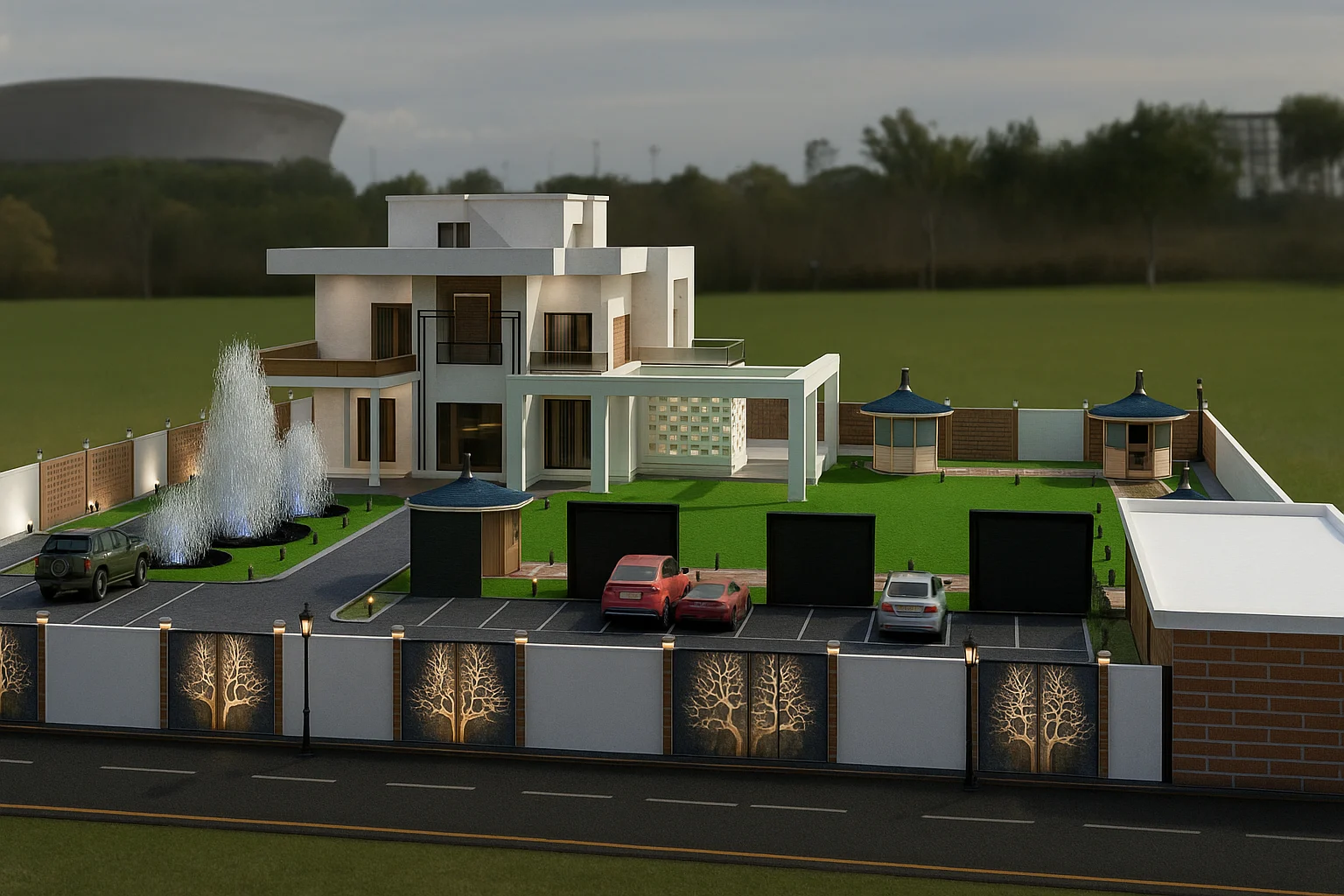
In hospitality design, the arrival sequence is arguably the most underestimated canvas in architecture. The moment a guest crosses the threshold — whether on foot or by vehicle — the building has already made its argument. Either it earns trust and curiosity, or it doesn't. At this luxury resort in Ghaziabad, ArchitectsHive treated arrival not as a logistical moment but as an architectural declaration.
The grand entrance and parking forecourt are designed with symmetrical precision — reflecting classical resort architecture in India principles while rendering them through an unmistakably contemporary lens. The axial approach draws the eye forward, building anticipation through controlled perspective. Lush greenery flanks the entry path, immediately cueing the visitor's nervous system: you are no longer in the city.
This kind of spatial storytelling — where modern architecture and landscape conspire to shift emotional states — is a hallmark of world-class design. It is also rare in the Ghaziabad hospitality market, which makes ArchitectsHive's execution here particularly significant for the region's evolving architectural identity.
"Great architecture begins before you open a door. It begins the moment you see the building across a lawn, sense its proportion, feel the ground beneath your feet shifting from street to sanctuary." — Design Principle, ArchitectsHive Studio
EXTERIOR ARCHITECTURE
Contemporary resort architecture in India faces a fundamental tension: the desire to impress versus the wisdom to understate. Too many luxury projects resolve this tension in favor of theatrical facades — bold curves, overscaled ornamentation, trend-chasing material choices — that age poorly and distract from the guest experience itself.
ArchitectsHive, widely recognized among the best architecture firms in Delhi NCR, took the harder road. The exterior of the Afzalpur Resort speaks in clean, horizontal geometry with controlled vertical punctuation. The neutral palette — anchored by natural stone textures, muted concrete finishes, and precision-cut metalwork — creates an elevation design of quiet authority. There is no single moment meant to photograph well; instead, every elevation reward prolonged observation.
The use of glazing is particularly sophisticated. Rather than treating glass as a showcase gesture, this leading architecture firm in Ghaziabad deploys it functionally: framing landscape views, channeling borrowed daylight into circulation corridors, and creating luminous facade moments that evolve as the sun tracks across the sky. The building truly changes hour by hour — a rare quality in modern resort design.
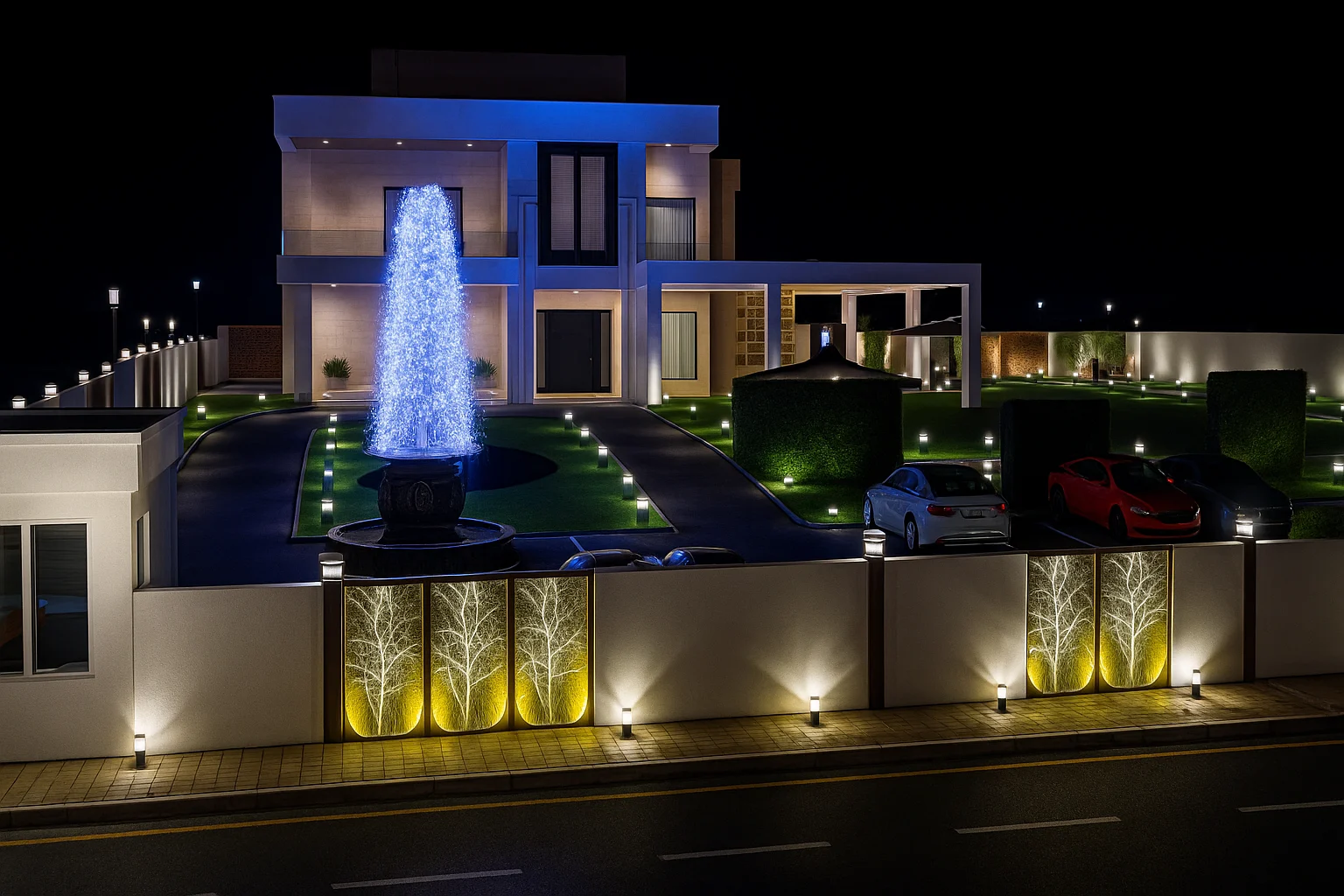
Post-dusk, the resort transforms again. Architectural lighting — concealed at ground level, embedded in canopy soffits, and layered across the entrance facade — shifts the building's emotional register from sophisticated restraint to cinematic warmth. This is not accent lighting; it's mood engineering — a signature of architectural and interior design firms in Ghaziabad that think in full 24-hour cycles.
LANDSCAPE ARCHITECTURE
In conventional resort development in India, landscape is often the last line item — the green layer applied after the "real" architecture is resolved. ArchitectsHive inverts this hierarchy entirely. At Afzalpur, landscape design in Ghaziabad was developed in parallel with the built form, meaning the two are not merely adjacent but genuinely interdependent. Remove the green, and the architecture loses its scale reference. Remove the building, and the garden loses its destination.
The resort's landscape strategy deploys several sophisticated layers. At the macro scale, open lawns provide spatial relief and event flexibility — critical for a property positioned at the intersection of destination wedding venues in Ghaziabad and premium corporate retreats, two of India's fastest-growing hospitality segments. These lawns are not passive voids but actively programmed spaces, shaped by berming, edge planting, and the strategic placement of gazebos and pavilions.
At the mid-scale, sculpted planting beds and specimen trees create visual depth and seasonal variation. The selection of native and adaptive plant species — a cornerstone of sustainable architecture in Ghaziabad — ensures the landscape performs reliably through the region's humid summers, mild winters, and monsoon season, without demanding intensive maintenance regimes.
At the intimate scale, water features serve a dual purpose: they provide acoustic masking, drowning the residual urban hum, and anchor focal points in the guest's visual field — creating the perception of a landscape far larger than the actual site boundaries suggest.
INTERIOR DESIGN
The global hospitality interior design conversation has shifted. The maximalist approach — all-white marble, oversized chandeliers, gold-everything — is giving way to something more nuanced: quiet luxury, a design vocabulary that signals refinement through restraint. The interior designers in Ghaziabad at ArchitectsHive were ahead of this curve when they conceived the Afzalpur interiors.
01 — Tectonic Honesty Materials are used for what they are, not disguised. Stone reads as stone, wood as wood. This honesty — central to contemporary hospitality design in India — creates an atmosphere of integrity that guests subconsciously trust.
02 — Vertical Generosity High ceiling volumes in key social spaces create a sense of occasion and psychological ease. Ceiling height is one of the most cost-effective tools in modern interior design in Ghaziabad for elevating perceived quality — used deliberately here, not universally.
03 — Controlled Aperture Natural light is managed as carefully as artificial light. Deep reveals, shading fins, and strategically positioned skylights ensure that daylight enters as an asset at every hour of the day — a defining feature of sustainable resort interiors.
04 — Programmatic Versatility The event and recreation zones are designed for furniture flexibility, acoustic adaptability, and service-point placement that supports everything from intimate private dining to large-scale destination wedding receptions in Delhi NCR.
05 — Durability as Design Finishes were selected for lifecycle performance under high-traffic hospitality conditions. Sustainable and durable material choices reduce the environmental footprint while lowering long-term costs — a genuine win-win rarely achieved in Indian resort architecture.
POOL DESIGN
In modern resort planning, the pool area has evolved from a recreational amenity into the property's social and visual centerpiece. It is the space most photographed, most coveted, and most indicative of the designer's overall skill. A poorly considered pool zone — regardless of the architecture elsewhere — undermines the entire hospitality design narrative.
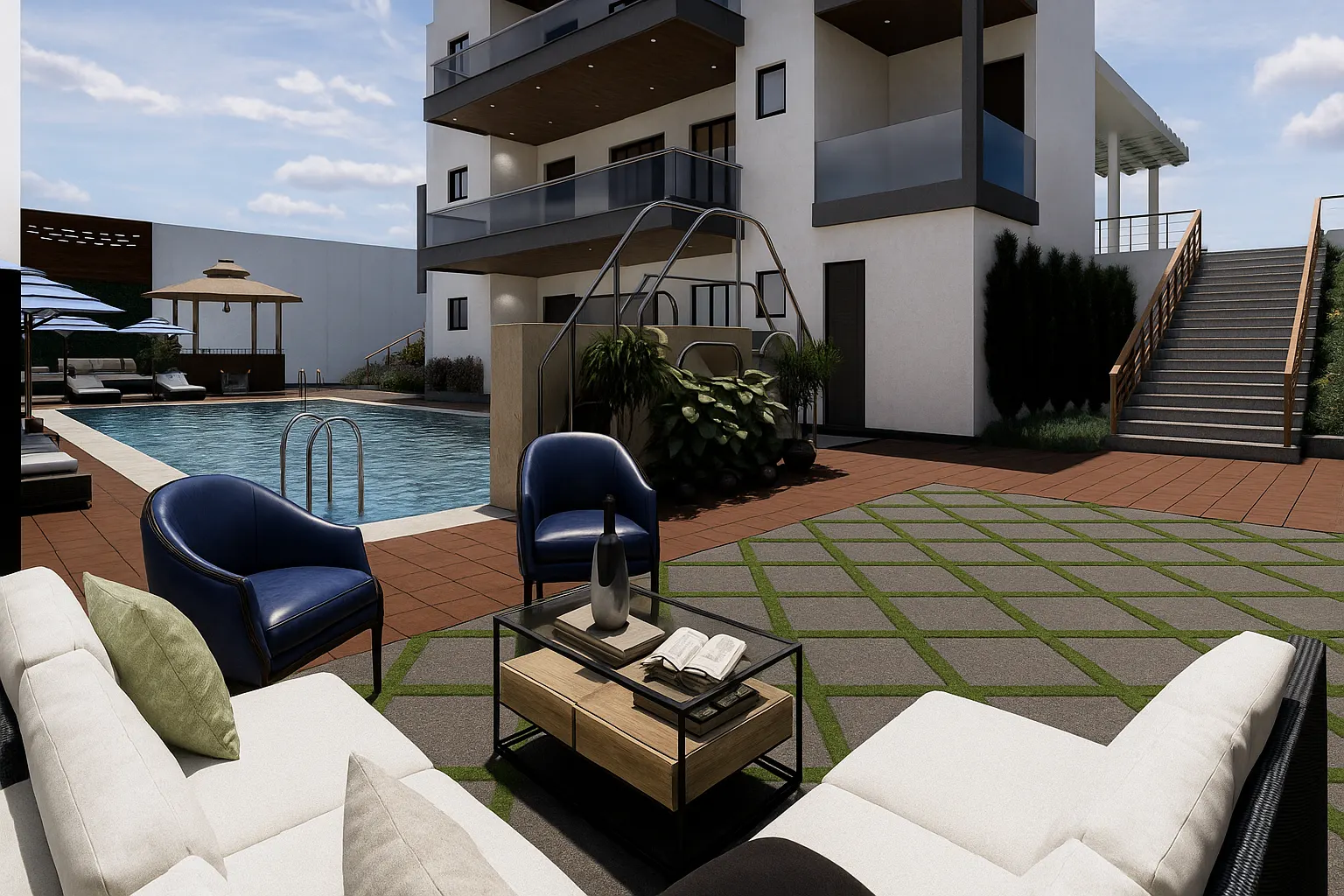
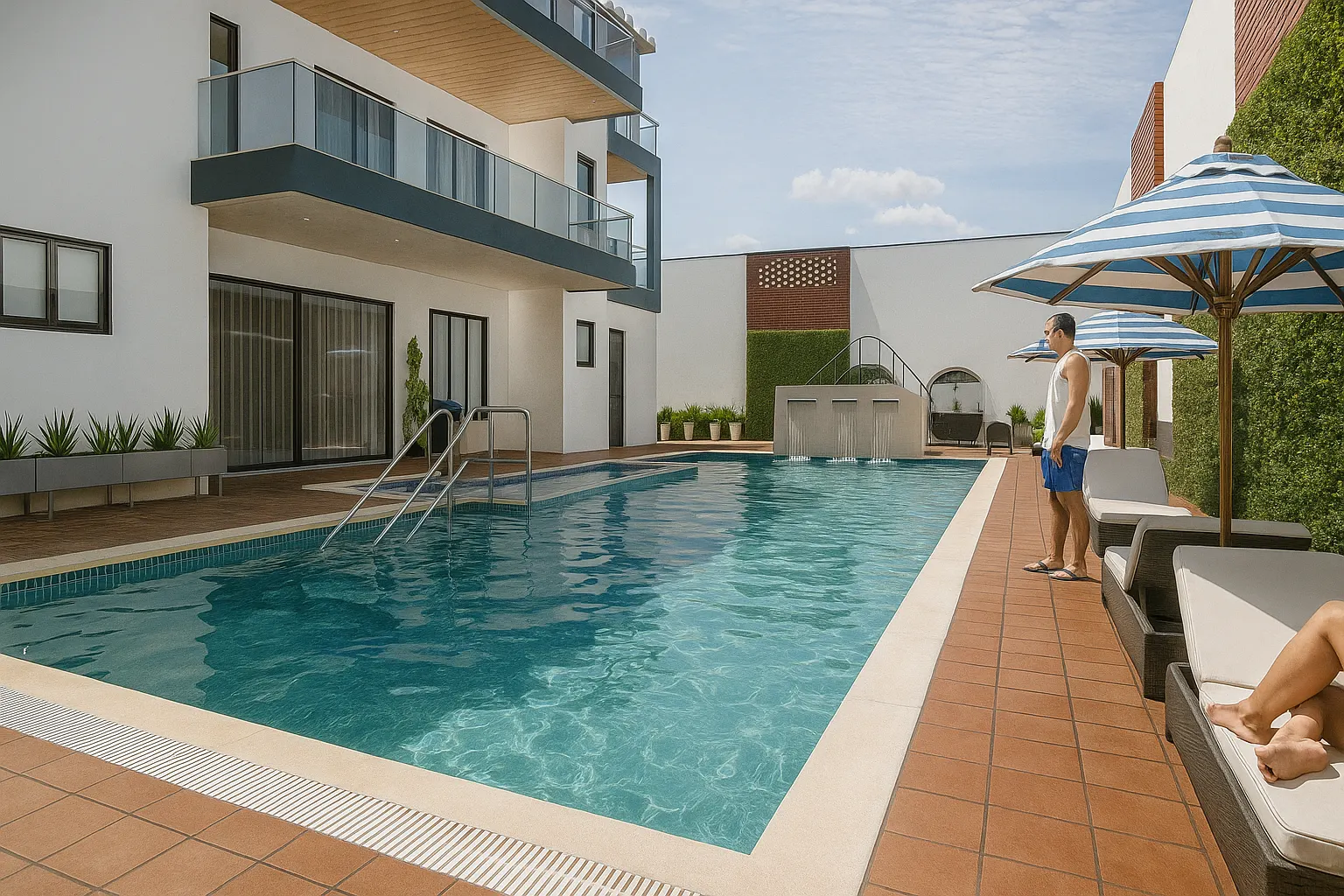
At Afzalpur, ArchitectsHive treats the pool precinct as its own micro-resort. Engineered hardwood decking creates warmth and natural texture against the clean water surface. Ergonomic loungers are positioned not merely for convenience but for view optimization — every seat has a considered relationship to the water, the greenery, and the surrounding resort architecture.
Shade provision deserves special mention. Rather than deploying generic umbrellas, this architecture firm in Delhi NCR integrates architectural canopy structures that provide dappled shelter while maintaining visual openness. Unbroken shade coverage can make outdoor spaces feel enclosed and heavy; architectural shade creates pattern, depth, and seasonal interplay with sunlight — a distinction only the best luxury resort designers in India understand.
The planting along the pool perimeter uses lush tropical species ecologically appropriate for the North Indian plains. The effect is transportive: guests feel, if only briefly, that they could be anywhere in the world. That sense of escape is the highest aspiration of resort design in Ghaziabad, and it is achieved here through landscape intelligence rather than imported materials.
SUSTAINABLE ARCHITECTURE
Sustainable architecture in India is no longer optional — it is the minimum expectation of any design practice that considers itself forward-thinking. At ArchitectsHive, sustainability is not a brochure claim — it's a set of measurable design decisions embedded from the first sketch, making this one of the most eco-conscious luxury resorts in Delhi NCR.
At the building envelope level, window-to-wall ratios are calibrated to balance daylighting and thermal performance. Deep-set glazing and external shading elements minimize solar heat gain during peak summer months — reducing cooling loads without sacrificing the visual connection to the landscape that defines this modern resort in Ghaziabad.
At the site scale, permeable paving in parking and pedestrian zones manages stormwater runoff responsibly, replenishing the water table rather than overwhelming municipal drains. The native plant palette dramatically reduces irrigation demand compared to conventional resort landscaping in India, which typically relies on water-intensive exotic species.
Material selection reflects a preference for locally sourced stone and regionally manufactured products — choices that reduce embodied carbon, support the local economy, and ensure that the architecture in Ghaziabad belongs to its landscape rather than being imposed upon it. These decisions accumulate into a building that will age gracefully, perform efficiently, and remain architecturally relevant for decades to come.
CONCLUSION
The Afzalpur Resort is significant not merely because it is beautiful — though it is — but because of what it represents for hospitality architecture in India at large. It demonstrates that world-class luxury resort design is entirely achievable in Tier-2 urban contexts without importing foreign aesthetics or compromising on ecological responsibility.
For Delhi NCR's architecture community, the project signals something important: that the region's best firms are no longer benchmarking themselves against local precedent alone, but against the finest hospitality projects globally. ArchitectsHive, through this project, confirms its standing as one of the top architecture firms in Ghaziabad — with proven mastery across planning, architecture, interiors, landscape, and sustainable systems.
For prospective clients across Ghaziabad, Delhi, Noida, and the broader NCR region, the Afzalpur Resort stands as a reference point: evidence that when you commission the right architecture and interior design firm in Ghaziabad, the result isn't just a building that functions or photographs well. It's a place that earns its way into people's memories — and that, perhaps, is the most important architectural achievement of all.
"Architecture is the art of how to waste space. But resort architecture is the art of how to fill space with feeling — with possibility, with peace, with the kind of unhurried presence that our daily lives have learned to forget." — ArchitectsHive Design Studio
📍 Serving: Ghaziabad | Noida | Greater Noida | East Delhi | West Delhi | North Delhi | South Delhi | Faridabad | Gurugram
✨ Your home is more than a building. Let's design something worth living in.
#ArchitectureConsultancyInNoida #ArchitectureConsultancyInDelhiNCR #CommercialArchitecture #ArchitectFirmsNearMe #CommercialBuildingDesign #FacadeDesignNoida #VastuCommercialDesign #ArchitectsHive #NoidaCommercialArchitecture #ModernCommercialDesign #HouseDesign #HomeDesign #InteriorDesign #ModernHouseDesign #BestArchitectsInGreaterNoida #ArchitectsInDelhiNCR #HomeConstruction #ResidentialArchitecture #LuxuryHomeDesign #ContemporaryHouseDesign #SustainableArchitectureIndia #EcoFriendlyHomeDesign #CustomHomeDesign #VillaDesign #2BHKHouseDesign #3BHKHouseDesign #SmartHomeDesign #ArchitectureAndInteriorDesign #CompactHomeDesign #EnergyEfficientHome #InteriorDesignersInNoida #FullHomeInterior #ExteriorHomeDesign #MinimalistArchitecture #VastuCompliantHouseDesign #ArchitectsInAligarh #BestArchitectsInUP #IndependentHouseDesign #DoubleStoreyHouseDesign #ModernHomeConstruction #ResidentialInteriorDesign #ContemporaryArchitectureIndia #ArchitectsHive #BestArchitectureFirm #HireArchitectForHome #BestArchitectNearMe
For More Detail Visit - 🌐 https://architectshive.com/
📞 +91 75034 68992 | +91 99586 00397
✉️ contact@architectshive.com
Gallery